More
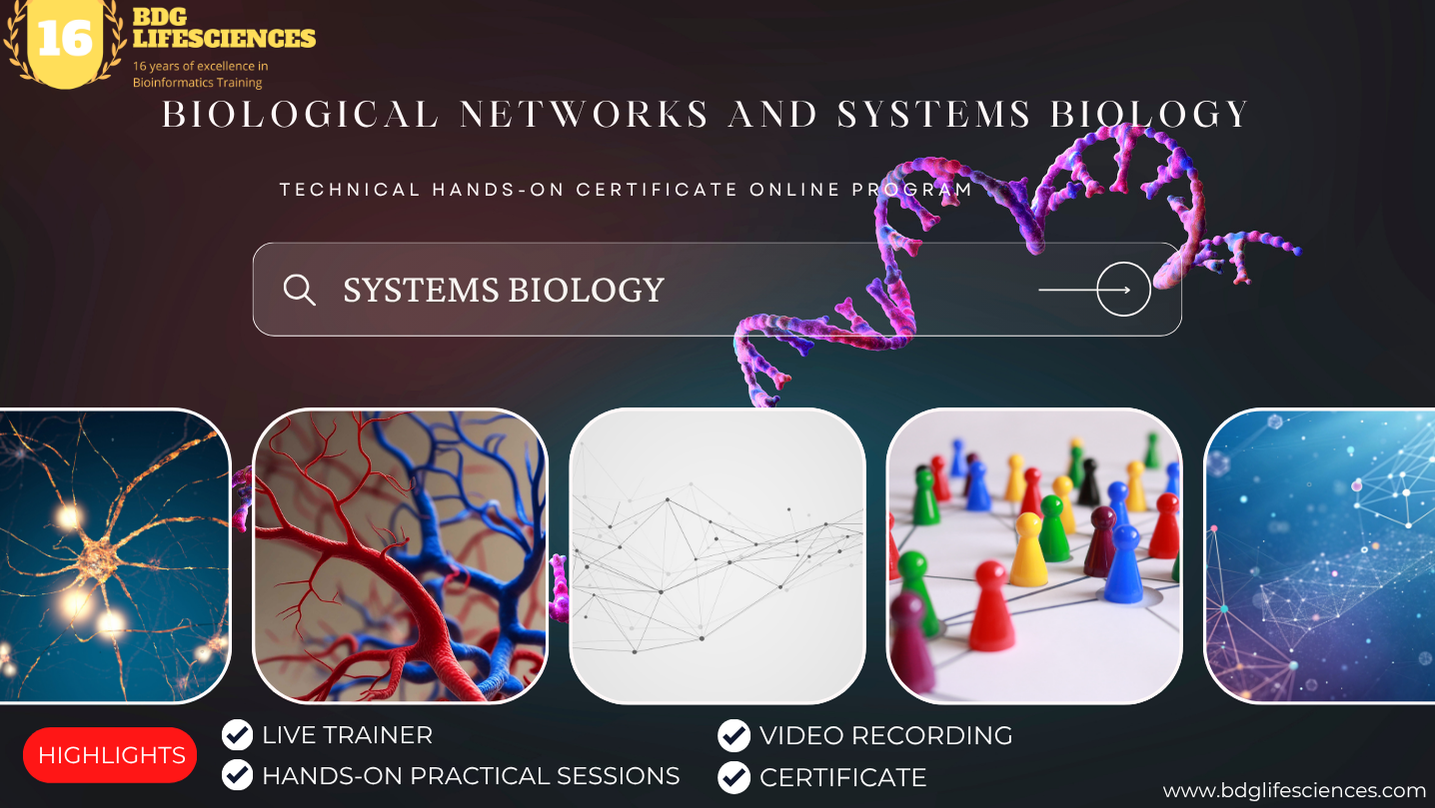
Biological Networks and Systems Biology Workshop Online of 5 days
A Five-Day Introduction to Biological Network Analysis, Pathway Enrichment, Systems Modelling and Data Integration
4.7

This Event Includes
- High demand video
- Learn from Experts
- Hands-on practical sessions
- Certificate on completion
Registration Fee |
|
In US $ |
$ 89 |
In Indian Rupees |
₹ 8593 |
Networks · Pathways · System Models · Data Integration — a structured five-day introduction to computational systems biology by BDG Lifesciences.
| 5 Days |
2 hrs Proposed per session |
4 Analytical modules |
1 Integrated practical |
Introduction
Biological systems are shaped by interactions between genes, proteins, pathways, and molecular processes. Understanding these relationships requires more than analysing individual genes: researchers also need to explore biological networks, interpret pathway enrichment results, understand basic system models, and integrate information from different data sources.
The 5-Day Biological Networks and Systems Biology Workshop by BDG Lifesciences introduces participants to these interconnected aspects of computational biology through a structured combination of scientific concepts and practical exercises.
Across five sessions, participants will explore protein–protein interaction (PPI) networks, pathway and enrichment analysis, introductory system models, and the integration of gene expression with protein or annotation data. Practical activities will use tools and resources such as STRING, BioGRID, Cytoscape, g:Profiler, BiGG, Google Colab, and Python/Pandas.
The programme also emphasises scientific interpretation and responsible analysis. Participants will examine network confidence scores, limitations of network hubs, weak or non-significant enrichment results, missing gene identifiers, and the importance of choosing an appropriate model for a biological question.
The workshop concludes with an integrated practical exercise that brings together network construction, enrichment analysis, biological interpretation, and data integration.
Workshop Dates
11 to 15 October, 2026. Live trainer will take online sessions from 8 PM - 10 PM India time (+5:30 GMT) time on Zoom.
Overview
The Biological Networks and Systems Biology Workshop is a five-day programme designed to introduce participants to complementary approaches for studying biological systems using computational tools. Each session builds on a different aspect of biological data analysis, progressing from network construction to pathway interpretation, system modelling, and data integration.
Workshop Learning Pathway
| Day 1 Biological Networks |
→ | Day 2 Pathway & Enrichment |
→ | Day 3 System Models |
→ | Day 4 Data Integration |
→ | Day 5 Integrated Practical |
Day 1 — Biological Networks
Explore protein–protein interaction, co-expression, and pathway networks. Learn about STRING and BioGRID, interaction confidence scores, confidence cut-offs, network hubs and their limitations, and the fundamentals of Cytoscape. The practical session covers PPI network construction, network export, visualisation, styling, and figure annotation.
Tools: STRING, BioGRID, Cytoscape
Day 2 — Pathway and Enrichment Analysis
Study Gene Ontology (GO), KEGG, Reactome, Over-Representation Analysis (ORA), and the fundamentals of Gene Set Enrichment Analysis (GSEA) using ranked gene lists. Practical activities include enrichment analysis, result interpretation, and preparation of a short biological interpretation, including consideration of weak or non-significant results.
Tools: g:Profiler, Enrichr, DAVID, WebGestalt
Day 3 — Introductory System Models
Understand the purpose of system models, the principles of Flux Balance Analysis (FBA), stoichiometric matrices, objective functions, and Boolean or logic models for signalling. Explore how to select a suitable model for a biological question and why large ordinary differential equation (ODE) models should not be fitted to small datasets.
Tools: BiGG, Cytoscape, lecture notebook
Day 4 — Combining Two Data Layers
Learn to map gene identifiers, distinguish matched from unmatched IDs, combine expression data with protein or annotation data, and handle missing identifiers. Practical work involves integrating two public datasets and generating a scatter plot or Venn diagram.
Tools: Google Colab, Python/Pandas, g:Profiler/g:Convert, bioDBnet
Day 5 — Integrated Practical, Revision and Assessment
Consolidate the previous four modules through an integrated hands-on practical involving network construction and visualisation, enrichment analysis, biological interpretation, and data-layer integration. The session also includes discussion, troubleshooting, and a final student output or assignment.
Tools: Resources used throughout the workshop
Programme format: Five days, with a proposed session duration of two hours per day.
Programme Time Allocation
Each of the five sessions has an equal proposed duration of two hours, so every module accounts for one-fifth of the programme.
| Day 1 Networks 20% |
Day 2 Enrichment 20% |
Day 3 Models 20% |
Day 4 Integration 20% |
Day 5 Integrated Practical 20% |
Tools & Resources by Day
| Tool / Resource | Day 1 | Day 2 | Day 3 | Day 4 |
| STRING | ● | |||
| BioGRID | ● | |||
| Cytoscape | ● | ● | ||
| g:Profiler | ● | ● | ||
| Enrichr | ● | |||
| DAVID | ● | |||
| WebGestalt | ● | |||
| BiGG | ● | |||
| Google Colab & Python/Pandas | ● | |||
| g:Convert & bioDBnet | ● |
Day 5 revisits resources used throughout the workshop.
The programme connects several important areas of computational biology while retaining a clear focus on practical exercises and the interpretation of scientific results.
Methodology
The workshop follows a progressive learning structure that combines conceptual instruction with practical application. Each session introduces a specific analytical area and connects it to relevant tools, examples, or exercises.
Conceptual Learning
Participants are introduced to the scientific principles underlying biological networks, pathway enrichment, system modelling, and data integration. The emphasis is on understanding what each approach represents, how it can be used, and where its limitations need to be considered.
Guided Practical Activities
The curriculum includes practical exercises using biological databases, network visualisation software, enrichment analysis platforms, and computational data-processing tools.
| Practical Area | What Participants Do |
| Network analysis | Select or prepare a gene list, construct a PPI network in STRING, examine interaction confidence, export the network, and visualise and style it in Cytoscape. |
| Enrichment analysis | Analyse a gene list, generate GO, KEGG, and Reactome results, interpret enriched pathways, and prepare a concise biological interpretation. |
| System modelling | Explore a metabolic model using BiGG and represent a small biological pathway as a Boolean or logic graph. |
| Data integration | Work with two public datasets, map gene identifiers, merge the data, identify matched and unmatched IDs, quantify missing mappings, and generate a scatter plot or Venn diagram. |
Integrated Application and Assessment
The fifth day brings together the main components of the programme. Participants work with a gene list and/or public datasets to apply network construction, enrichment analysis, biological interpretation, and data-layer integration in an integrated practical exercise. The session also includes revision, discussion of results, troubleshooting, and a final student output or assignment.
The instructor is expected to prepare presentation materials, practical datasets, step-by-step instructions, and software installation or setup guides. These materials are intended to support the delivery of the practical sessions.
Target Audience for This Program
This workshop may be relevant to learners and professionals who want to develop an introductory understanding of biological networks, systems biology, and the computational analysis of biological data. Suitable audiences include:
- Undergraduate students in life sciences: Students seeking an introduction to biological networks, pathway analysis, and computational approaches to biological questions.
- Postgraduate students and master’s scholars: Learners interested in exploring gene and protein interactions, pathway enrichment, and the integration of biological datasets.
- PhD scholars and early-career researchers: Researchers who want to understand how network analysis, enrichment results, system models, and multiple data layers can contribute to their research.
- Bioinformatics and computational biology learners: Individuals seeking exposure to tools such as STRING, Cytoscape, g:Profiler, BiGG, and Python/Pandas for biological data analysis.
- Molecular biology, biotechnology, genetics, and related life science researchers: Individuals interested in connecting experimental findings with network-based or computational analysis.
The programme introduces foundational system-modelling concepts and includes practical data-analysis exercises. However, the curriculum does not specify formal eligibility requirements or a complete prerequisite list. Participants should confirm the expected level of prior knowledge and any software setup requirements with the organiser before registering.
Why You Should Attend
Biological datasets often contain information about different aspects of the same system. Network analysis helps represent relationships between biological entities, enrichment analysis helps investigate the functional context of gene lists, system models provide ways to represent biological processes, and data integration enables researchers to compare information from different sources. This workshop brings these approaches together in a single five-day programme.
- Understand biological relationships beyond individual genes. Explore the differences between PPI, co-expression, and pathway networks, and learn why interaction confidence and the limitations of network hubs matter when interpreting network results.
- Connect gene lists with biological functions. Work with GO, KEGG, and Reactome enrichment results while learning to interpret weak or non-significant findings rather than relying solely on significant results or visual outputs.
- Explore different approaches to modelling biological systems. Become familiar with FBA, stoichiometric matrices, objective functions, and Boolean or logic models, including the importance of selecting a model appropriate to the research question.
- Learn to combine complementary biological datasets. Practise gene identifier mapping and dataset merging while examining unmatched identifiers and missing data that may affect downstream interpretation.
- Bring the concepts together. The final integrated practical connects network visualisation, enrichment analysis, biological interpretation, and data integration, providing an opportunity to consider how these methods relate to one another.
The programme is particularly relevant to participants who want to understand not only how computational tools produce results, but also how those results should be interpreted and their limitations communicated.
What Are the Benefits of This Program?
The workshop is structured to provide introductory knowledge and practical exposure across four complementary areas of computational biology, followed by an integrated exercise. By engaging with the listed topics and activities, participants may develop the following capabilities.
Biological Network Construction and Visualisation
- Understand the differences between protein–protein interaction, co-expression, and pathway networks.
- Explore interaction confidence scores and cut-offs, and understand the limitations of network hubs.
- Practise constructing a PPI network using STRING and transferring it to Cytoscape.
- Apply network layouts, styling, node and edge properties, and legends to produce a network figure that includes its source and confidence score.
Pathway and Enrichment Analysis
- Understand the roles of GO, KEGG, and Reactome in functional and pathway analysis.
- Gain practical exposure to Over-Representation Analysis and an introduction to GSEA and ranked gene lists.
- Generate and interpret enrichment results using the listed analysis platforms.
- Prepare a short biological interpretation of enrichment findings and recognise why weak or non-significant results require careful evaluation.
Introductory Systems Modelling
- Understand the purpose of system models in biological research.
- Explore the basic principles of Flux Balance Analysis, including the stoichiometric matrix and objective function.
- Represent a small biological pathway as a Boolean or logic graph.
- Develop an introductory understanding of how model selection relates to the biological question and available data.
Integration of Biological Datasets
- Understand gene identifier mapping across Symbol, Entrez, Ensembl, and UniProt identifiers.
- Practise combining expression data with protein or annotation data.
- Identify matched and unmatched identifiers and calculate failed or missing mappings.
- Generate a scatter plot or Venn diagram to represent relationships between the integrated datasets.
Integrated Application and Scientific Interpretation
The final session provides an opportunity to connect the previous modules through an integrated practical exercise. Participants will work with a gene list and/or public datasets, revisit key concepts, discuss results, troubleshoot issues, and complete a final student output or assignment.
These outcomes represent the intended learning opportunities provided by the curriculum. The level of independent proficiency achieved will depend on participants’ starting knowledge, engagement, and subsequent practice.
How It Will Help You in Your Career
Biological network analysis, pathway enrichment, systems modelling, and data integration are relevant to several types of computational and experimental research. Familiarity with these approaches can help researchers understand how biological data are represented, analysed, and interpreted. The workshop provides introductory exposure to these methods and their potential applications in academic and research settings.
| Area | How the Workshop May Help |
| Bioinformatics and computational biology research | Network construction and Cytoscape visualisation may help participants explore molecular relationships and communicate network-based findings in research projects. |
| Genomics and molecular biology projects | Pathway enrichment and biological interpretation can support the investigation of gene lists arising from experimental studies, provided the underlying data and analysis are appropriate. |
| Postgraduate and doctoral research | Understanding model selection, enrichment results, and data integration may help researchers evaluate computational methods and identify approaches relevant to their research questions. |
| Multidisciplinary research | The combination of biological networks, pathway analysis, system models, and data integration provides a foundation for communicating with researchers working across molecular biology, computational biology, and systems biology. |
| Scientific data analysis | Practical exposure to Python/Pandas, Google Colab, and gene identifier mapping may help participants understand common data-processing tasks encountered when working with public biological datasets. |
The workshop can serve as a foundation for further study and independent practice. It does not, by itself, establish professional competency in all these areas or guarantee employment, admission to a research programme, publication, or other career outcomes.
Why Choose BDG Lifesciences for This Program?
BDG Lifesciences is a bioinformatics training and contract research organisation established in 2010. Its work spans computational life sciences education and research-related services. The Biological Networks and Systems Biology Workshop aligns with this focus by introducing participants to established biological databases, computational analysis resources, and practical approaches used to investigate biological relationships and datasets.
| Established in 2010 BDG Lifesciences has an established history in bioinformatics training and contract research. |
Scientific and computational training The organisation provides training across computational life sciences subjects, connecting scientific concepts with relevant analytical methods. |
| Experience across multiple countries BDG Lifesciences has experience delivering training to participants in multiple countries. |
A curriculum spanning complementary methods This programme connects network analysis, enrichment analysis, introductory systems modelling, and data integration within a structured five-day format. |
The curriculum also includes practical datasets, step-by-step instructions, presentation materials, and installation or setup guides as planned resources for workshop delivery.
For prospective participants, the key consideration is the fit between the programme’s introductory scope and their learning objectives. Those seeking a structured introduction to these complementary computational biology methods can use the curriculum to assess its relevance to their current studies or research.
Registration Fee
Simple, Transparent Pricing
One fee for all participants.
$89 US Dollars or ₹8593 Indian Rupees | No hidden charges. Includes live sessions, session recordings, and completion certificate.
Registration is non-refundable and non-transferable. Please read the full T&C below before registering.
Frequently Asked Questions (FAQs)
1. What is the Biological Networks and Systems Biology Workshop about?
The workshop introduces biological network analysis, pathway and enrichment analysis, introductory system models, and the integration of biological datasets. It combines conceptual learning with practical exercises and concludes with an integrated practical, revision, and assessment.
2. How long is the workshop?
The programme runs over five days, with a proposed session duration of two hours per day. The final schedule and confirmed dates should be checked with BDG Lifesciences before registration.
3. What will I learn about biological networks?
You will explore PPI, co-expression, and pathway networks, along with STRING, BioGRID, interaction confidence scores, confidence cut-offs, and network hubs. The practical includes constructing a PPI network in STRING, exporting it, and visualising and styling it in Cytoscape.
4. Which tools are used for pathway and enrichment analysis?
The curriculum lists g:Profiler, Enrichr, DAVID, and WebGestalt for enrichment analysis, with GO, KEGG, and Reactome as functional or pathway resources. You will explore enrichment analysis, interpret pathway results, and prepare a short biological interpretation.
5. Does the workshop cover Gene Set Enrichment Analysis (GSEA)?
Yes. The curriculum includes an introduction to GSEA and ranked gene lists. It also covers Over-Representation Analysis (ORA) and the interpretation of weak or non-significant pathway results.
6. What is covered in the systems modelling session?
Day 3 introduces system models, Flux Balance Analysis, stoichiometric matrices, objective functions, and Boolean or logic models for signalling. Practical activities include exploring a model using BiGG and redrawing a small biological pathway as a Boolean or logic graph.
7. Will I learn to integrate different biological datasets?
The curriculum includes a practical exercise using two public datasets. You will work with gene identifier mapping, dataset merging, matched and unmatched IDs, missing mappings, and the generation of a scatter plot or Venn diagram.
8. Which software and resources are required?
The listed resources include STRING, BioGRID, Cytoscape, g:Profiler, Enrichr, DAVID, WebGestalt, BiGG, Google Colab, Python/Pandas, g:Convert, and bioDBnet. Cytoscape installation and basic setup are planned for Day 1. Confirm any computer, installation, or access requirements with the organiser before the workshop.
9. Who should attend this workshop?
The programme may suit life sciences students, postgraduate researchers, PhD scholars, bioinformatics learners, and researchers interested in computational analysis of biological data. Formal eligibility criteria and prerequisites have not been specified in the curriculum, so participants should confirm whether their background is suitable before registering.
10. Is the workshop suitable for beginners?
The curriculum includes introductory concepts, particularly for system modelling, and introduces participants to several computational tools. However, it does not formally establish that the entire programme is suitable for complete beginners or specify prerequisite knowledge. Contact the organiser if you are new to bioinformatics or computational data analysis.
11. What happens on the final day?
Day 5 includes revision of the first four modules, an integrated hands-on practical, discussion of results, troubleshooting, and a final student output or assignment. The integrated exercise connects network construction and visualisation, enrichment analysis, biological interpretation, and data-layer integration.
12. Will I receive a certificate, workshop recordings, or post-workshop support?
These details are not established in the supplied curriculum. Please confirm certificate arrangements, access to recordings, post-workshop support, delivery format, fees, and registration details directly with BDG Lifesciences before enrolling.
Registration
How To Register
Secure your spot in 3 simple steps — seats are limited for each batch.
1️⃣ Click Register Now- Click the Register Now button and select number of tickets you want to buy..
2️⃣ Check Your Confirmation Email- After successful payment, check your email for a confirmation with registration details and next steps.
3️⃣ Receive Your Zoom Link- Once registration closes, you'll receive the Zoom meeting link and be added to the workshop WhatsApp group.
📧 Need help? Email us at workshops@bdglifesciences.com or chat with our AI Assistant George at bdglifesciences.com
T & C
- For this event the Fee is same for all participants which is $ 89 US equivalent to 8593 Indian Rupees.
- Please provide a GMAIL ID for registration as the recorded video session will be provided on YouTube. Kindly provide that email ID by which you use YouTube.
- Video recording of each session will be provided at the end of the session to give the user a unique learning experience.
- Interactive training sessions will be conducted on Google Meet/Zoom so to give users a better learning experience.
- As it is with a LIVE TRAINER hence practical application, i.e., the experiments/tasks to be performed can be done in the best explainable manner.
- In this Online Workshop, there will be a LIVE trainer who will solve queries along with training.
- The program is SELF-PACED. After each session video of that particular session will be shared with you so you can go through as many times as you want and perfect yourself in the topics & tasks.
- If you miss any session then NO PROBLEM you can still perform the tasks by going through the video of that particular session.
- Make sure you register under the right category. If you register under the wrong category then your registration will be invalid and NO REFUND WILL BE MADE IN THIS CASE. This is your mistake and the company is not responsible for it.
- To avoid this do read the description of the ticket before selecting and proceeding with payment.
- You need to upload your professional ID which can be your Student ID Card or Research Institute ID Card or Company ID Card. DO NOT UPLOAD EXPIRED ID OR ANY GOVERNMENT ID LIKE AADHAR, PAN, you have to upload professional ID.
- If you are currently not employed or not studying, you may upload the professional ID from your previous affiliation (degree or company), provided you are registering under the correct category. If you are in India, or will be in India at the time of the workshop or training or research project, your category will be Participants in India, and you can upload any valid ID (including one from your previous affiliation). If, at the time of the workshop or training or research project, you are not in India, your category will be Participants outside India, and you can upload any valid ID.
- After registration, you will join the workshop's WhatsApp group. If you have registered in the "Participants in India" category, you must join using an Indian phone number only.
- The certificate will be issued as per the details which you provide in the registration form while registering before payment.
- Once you register relax we will send you the meeting link after the workshop registration gets over.
- We want to make sure that you learn properly hence the training certificate will be given ONLY on successful completion of all the tasks given by the trainer.
- The certificates of all our Online programs are sent by email(softcopy) which has a unique barcode. You can take a print of that on heavy cardstock or photo paper and get it laminated if required.
- The registration is NON-REFUNDABLE and NON-TRANSFERABLE.
- BDG Lifesciences reserves the right of admission in all our programs.
- If you are removed or your registration is canceled then there will be no answer to that. We have our own reasons for such an act of ours
- If we do not wish to give this workshop to any participant then we will refund their amount.
- You should also read the Terms & Conditions page as well as the FAQs page. For any assistance kindly chat with our AI Assistant George on the website www.bdglifesciences.com.
BDG LifeSciences
BDG LifeSciences is a distinguished bioinformatics company established in 2010 and operates globally. Headquartered in India, the company specializes in facilitating workshops, training programs, novel and innovative research projects, and online courses in bioinformatics and life sciences. BDG LifeSciences is registered under the Ministry of MSME (Micro, Small, and Medium Enterprises), Government of India, with the registration number UDYAM-UP-01-0019151. In January 2024, BDG LifeSciences, India, has authorized BBR Group Pty Ltd., Australia (ACN 608 550 849), to operate its programs in Australia and New Zealand.
With a strong focus on the practical application of technology, BDG LifeSciences provides hands-on training where participants work on their own computers/laptops using specialized software and servers. The company has been a leader in this sector for the last 16 years, successfully educating a diverse range of participants, including students, scientists, faculty members, professors, and corporate executives worldwide.
Programs
Related Workshops
- Bioinformatics Workshop
- Drug Discovery & Design
- Molecular Docking Workshop
- MD Simulations Workshop
- WGS Analysis Workshop
- NGS Healthcare Workshop
- Transcriptomics Workshop
Company
- About Us
- Publications
- Advisors & Collaborators
- Blogs
- Careers
- FAQs
- Terms & Conditions
- Privacy Policy
- Contact Us
© 2026 BDG Lifesciences. All Rights Reserved. | 16+ Years of Bioinformatics Excellence | Trusted by 2,000+ Participants in 40+ Countries Privacy Policy · Terms & Conditions
Recommended Just for You