More
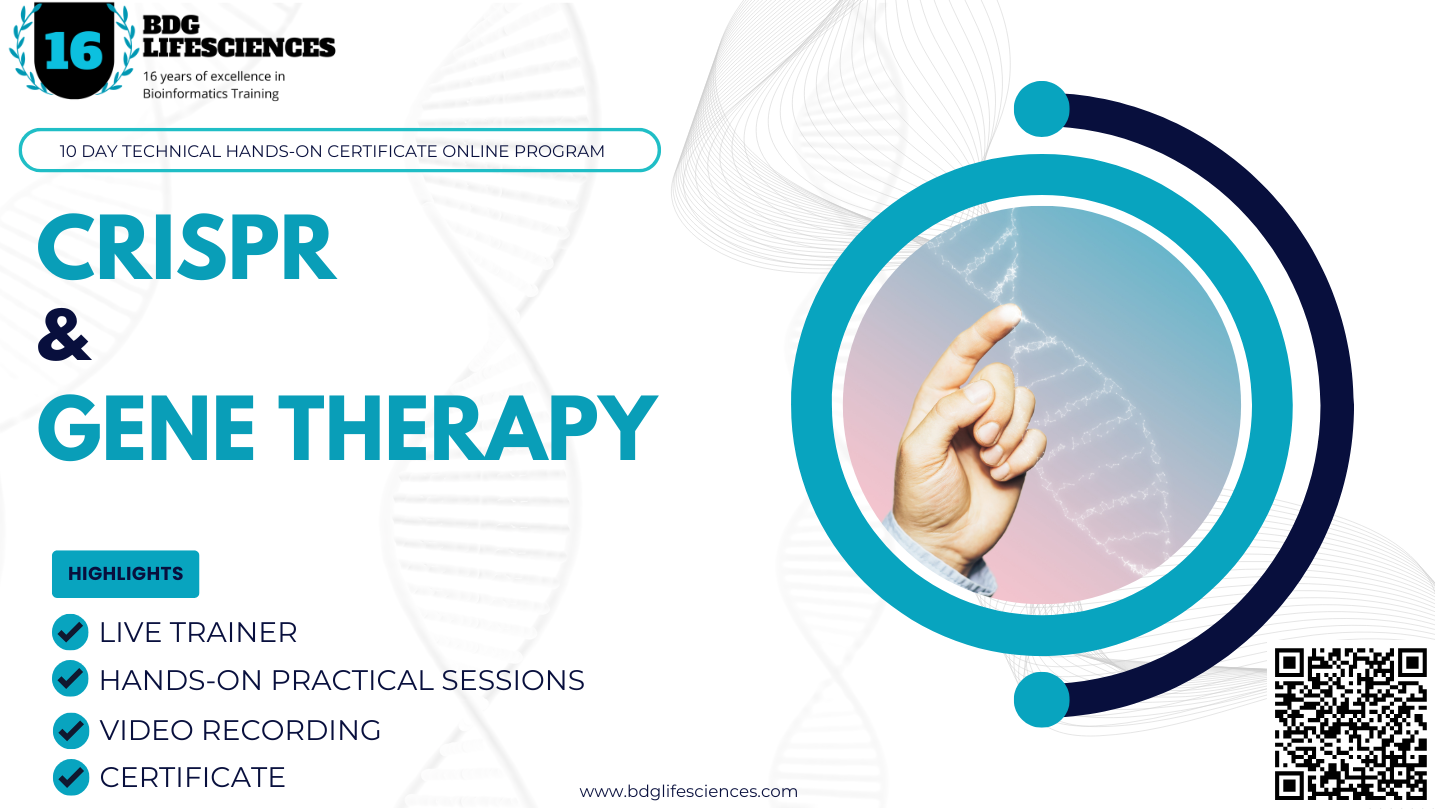
CRISPR Gene Therapy Online Workshop
Master sgRNA design, off-target analysis, base editing, prime editing, HDR template design & Cas protein structural analysis
4.7
This Event Includes
- High demand video
- Learn from Experts
- Hands-on practical sessions
- Certificate on completion
Registration Fee |
|
In US $ |
$ 199 |
In Indian Rupees |
₹ 19196 |
What is This CRISPR and Gene Therapy Workshop?
In less than a decade, CRISPR-Cas technology has moved from a bacterial immune defence mechanism discovered in a laboratory to a Nobel Prize-winning breakthrough that is actively rewriting the treatment of cancer, genetic disorders, and infectious disease. The world's first approved CRISPR-based therapy — Casgevy — was cleared for sickle cell disease in 2023. Dozens more are in clinical trials. The question for anyone working in life sciences, biotechnology, molecular biology, or biomedical research is no longer whether CRISPR matters — it is whether you have the training to work with it.
BDG LifeSciences — established in 2010, MSME-registered under the Government of India, and globally authorised to operate in Australia and New Zealand via BBR Group Pty Ltd — has been delivering expert-led, hands-on bioinformatics and life sciences training for over 16 years. We proudly present our expanded 10-Day Technical Hands-On Certificate Online Workshop in CRISPR and Gene Therapy — a scientifically grounded, application-oriented programme that takes participants from the biological foundations of CRISPR all the way through guide RNA design, off-target analysis, base editing, prime editing, HDR template design, and structural interpretation of Cas proteins.
This programme has been expanded from its earlier 5-day format into a comprehensive 10-day structure to provide greater depth, better workflow continuity, and stronger practical orientation. Each session runs for 60–90 minutes with the BDG LifeSciences Technical Team delivering live, expert instruction via Zoom. Participants work directly on in silico CRISPR design tools — not passive slides — using real genomic sequences, multiple prediction servers, and real-world disease targets.
By the end of 10 days, participants will not just understand CRISPR — they will be able to design, evaluate, and validate a complete CRISPR guide RNA workflow from sequence retrieval to off-target assessment to primer and HDR template design. A Certificate of Completion with a unique verification barcode is awarded on successfully completing all assigned tasks.
Workshop Dates are 22 to 31 October, 2026. Live trainer- Online sessions from 9 PM - 10:30 PM India time +5:30 GMT
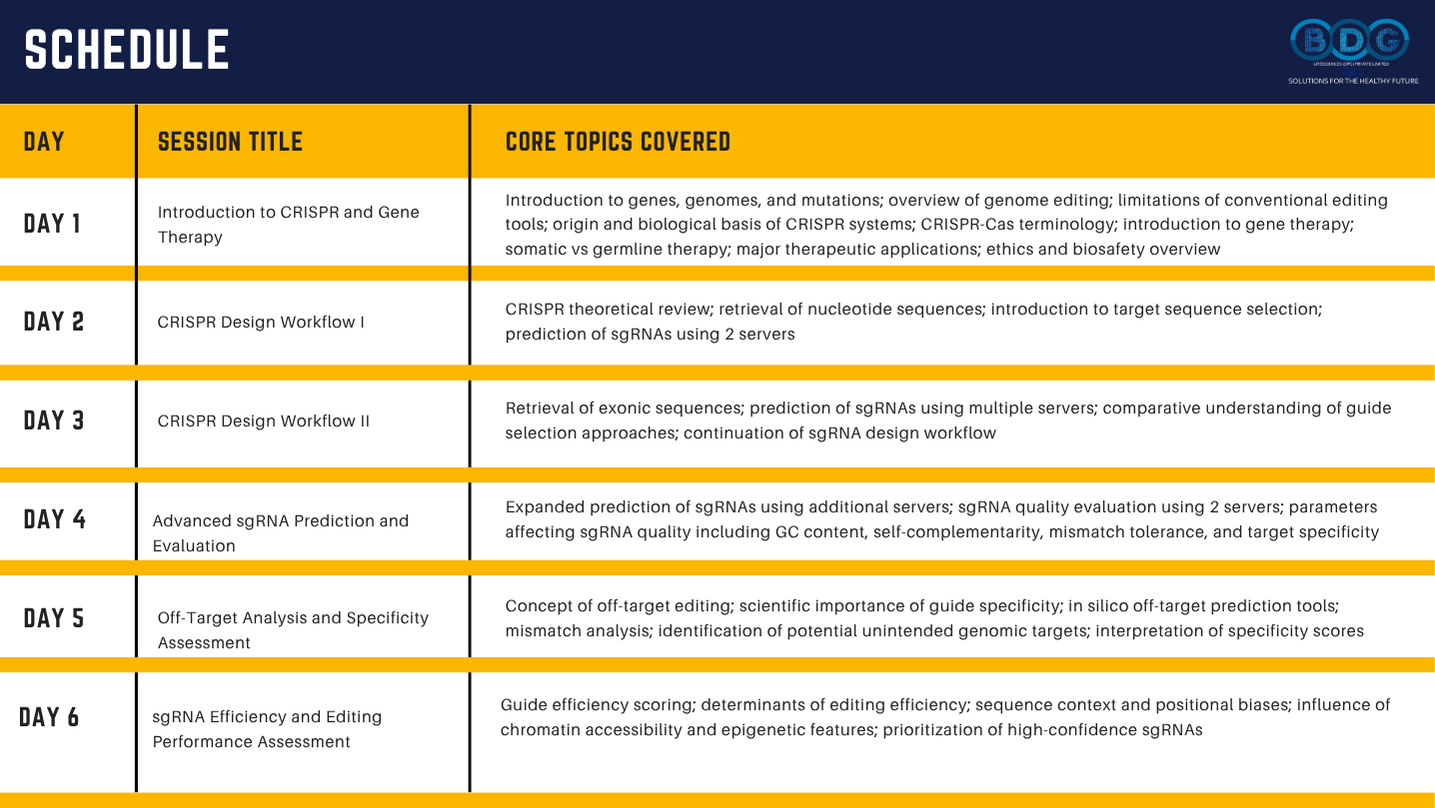
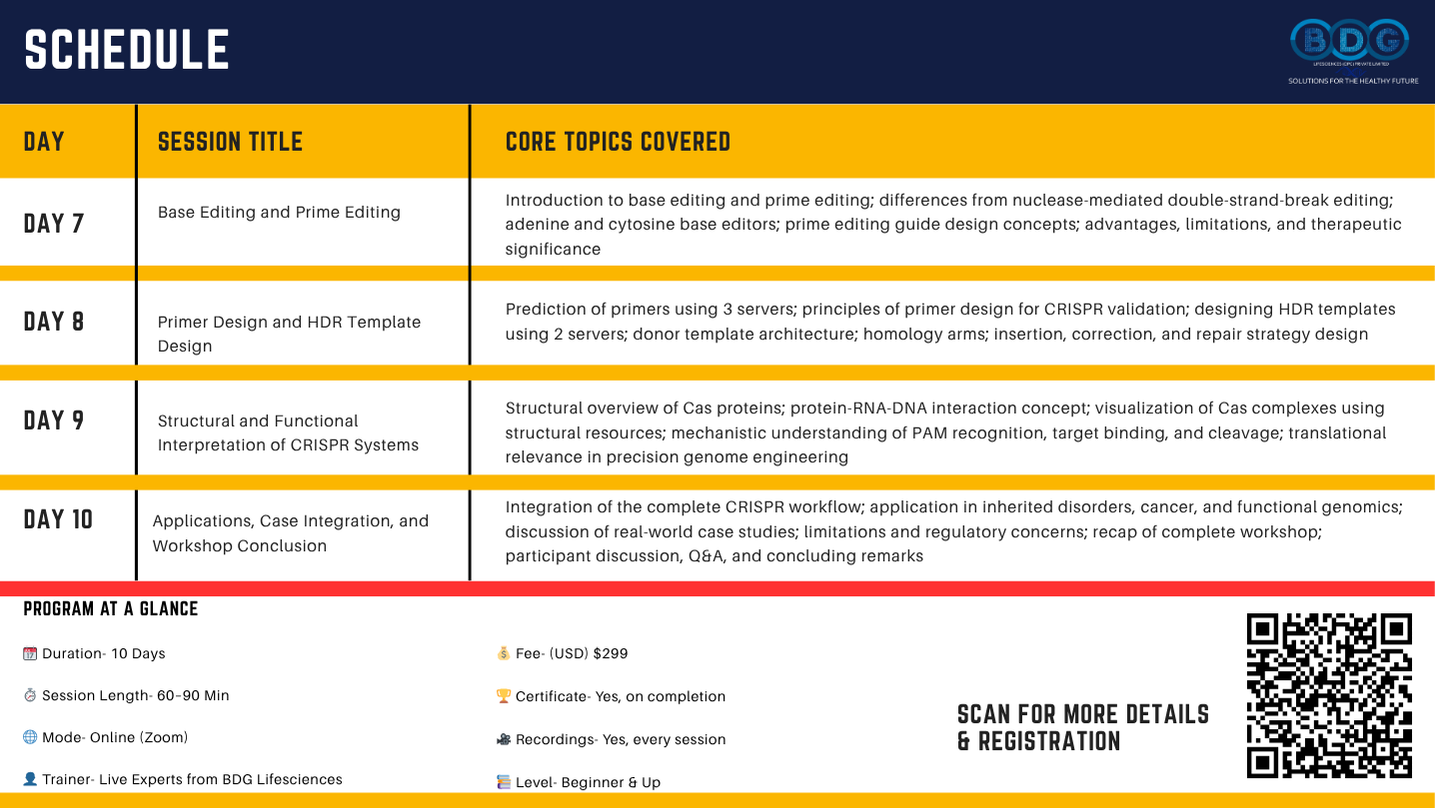
10-Day CRISPR & Gene Therapy Workshop — Day-by-Day Curriculum
A structured 10-day progression from CRISPR fundamentals and gene therapy concepts through sgRNA design, off-target analysis, base and prime editing, primer and HDR template design, Cas protein structural interpretation, and real-world clinical applications.
▶ PHASE 1 — Foundations (Days 1–3)
|
DAY 01 — Introduction to CRISPR and Gene Therapy
📌 Learning Outcome: Explain the mechanism of CRISPR-mediated editing and the conceptual framework of gene therapy with scientific accuracy |
|
DAY 02 — CRISPR Design Workflow I
📌 Learning Outcome: Retrieve target gene sequences and generate initial sgRNA predictions using multiple bioinformatics platforms |
|
DAY 03 — CRISPR Design Workflow II
📌 Learning Outcome: Design and compare sgRNAs across multiple servers and build a rational candidate guide shortlist |
▶ PHASE 2 — Guide Evaluation & Specificity (Days 4–6)
|
DAY 04 — Advanced sgRNA Prediction and Quality Evaluation
📌 Learning Outcome: Evaluate sgRNA quality using multiple parameters and rank candidate guides based on efficiency and specificity criteria |
|
DAY 05 — Off-Target Analysis and Specificity Assessment
📌 Learning Outcome: Perform comprehensive in silico off-target analysis and select sgRNAs with the highest specificity and lowest off-target risk |
|
DAY 06 — sgRNA Efficiency and Editing Performance Assessment
📌 Learning Outcome: Integrate efficiency, specificity, and quality metrics to prioritise the optimal sgRNA for experimental use |
▶ PHASE 3 — Advanced Editing Strategies & Validation Design (Days 7–8)
|
DAY 07 — Base Editing and Prime Editing
📌 Learning Outcome: Understand and distinguish base editing and prime editing strategies and identify appropriate clinical applications for each |
|
DAY 08 — Primer Design and HDR Template Design
📌 Learning Outcome: Design validation primers and HDR donor templates for CRISPR correction and insertion experiments |
▶ PHASE 4 — Structural Understanding & Translational Integration (Days 9–10)
|
DAY 09 — Structural and Functional Interpretation of CRISPR Systems
📌 Learning Outcome: Interpret the 3D structure of CRISPR-Cas complexes and connect structural features to mechanistic and therapeutic understanding |
|
DAY 10 — Applications, Case Integration, and Workshop Conclusion
📌 Learning Outcome: Apply the complete CRISPR workflow to real disease targets and articulate the clinical, regulatory, and scientific landscape of gene therapy |
In Silico Tools & Platforms Used in This Workshop
|
NCBI Nucleotide Target sequence retrieval |
Multiple sgRNA Servers Guide RNA design & prediction |
Off-Target Prediction Tools Specificity & mismatch analysis |
sgRNA Quality Servers Efficiency & GC content scoring |
|
Primer Design Servers PCR & sequencing primer design |
HDR Template Servers Donor template & homology arm design |
Structural Biology Resources Cas protein 3D visualisation |
Base & Prime Editing Tools pegRNA design & ABE/CBE planning |
Why You Should Attend This CRISPR and Gene Therapy Workshop
CRISPR is not a future technology. It is a present-day clinical and research reality — and employers, grant committees, and academic institutions are actively seeking professionals who can work with it. Here is exactly why this 10-day program will transform your skills and career:
|
Master the Complete CRISPR Design Workflow — End to End Most CRISPR courses teach the concept. This workshop teaches the workflow. By Day 10 you will have independently completed a full CRISPR pipeline — from retrieving a target gene sequence, designing and ranking sgRNAs, running off-target analysis, scoring efficiency, designing primers, building HDR templates, and interpreting Cas protein structure. This is the workflow used in real research labs and published papers. |
10 Days of Structured Depth — Not a Rushed Overview The expanded 10-day format was deliberately designed to give participants the time and depth that CRISPR technology deserves. Day 1 builds foundations. Days 2–3 introduce the design workflow. Days 4–6 develop evaluation and specificity skills. Days 7–8 cover advanced editing strategies. Days 9–10 address structural understanding and real-world clinical integration. Each day builds on the last — no gaps, no jumps. |
|
Learn Advanced Topics Most CRISPR Courses Never Cover Base editing, prime editing, pegRNA design, HDR template architecture, homology arm design, chromatin accessibility effects on guide efficiency, and structural interpretation of Cas proteins — these are advanced topics that define the frontier of CRISPR research. This workshop covers all of them, in depth, with guided practical sessions. |
Directly Applicable to Your Research and Publications Every analysis performed in this workshop — sgRNA design tables, off-target reports, efficiency scores, primer designs, HDR template maps — is directly usable in your thesis, dissertation, grant proposal, or research paper. Participants leave with real outputs, not just theoretical understanding. These are standard components of CRISPR-based publications. |
|
Understand the Clinical & Regulatory Landscape of Gene Therapy Day 10 integrates the entire workshop into a clinical context — discussing approved therapies (including Casgevy for sickle cell disease), ongoing clinical trials, regulatory frameworks, germline editing ethics, and the future trajectory of CRISPR-based medicine. This translational understanding is what separates technically capable researchers from scientifically rounded professionals. |
Earn a Globally Recognized Certificate with Unique Barcode Participants who successfully complete all assigned tasks receive a BDG LifeSciences Certificate of Completion carrying a unique barcode for independent verification — recognized by academic institutions and employers across India, Australia, New Zealand, and internationally. Add it to your LinkedIn, portfolio, or university application immediately. |
|
Career Relevance in One of the Fastest-Growing Fields in Medicine The global CRISPR and gene therapy market is projected to exceed $38 billion by 2030. Pharma companies, CROs, genomics firms, and academic institutions are actively hiring scientists with verifiable, hands-on CRISPR expertise. This workshop and certificate directly strengthens your profile for roles in computational genomics, gene editing research, drug discovery, molecular biology, and clinical research. |
Session Recordings — Revisit Every Step of Every Analysis Every session is recorded and shared with participants after each class via YouTube. CRISPR design workflows involve multi-step server-based analyses — the recordings allow you to pause, rewind, and re-run every step at your own pace until each task is fully mastered. |
Who Should Attend This CRISPR & Gene Therapy Workshop?
This workshop is designed for anyone in life sciences who wants to understand, design, and apply CRISPR technology — from undergraduate students encountering it for the first time to PhD researchers looking to formalise and advance their computational CRISPR skills. No prior CRISPR or bioinformatics experience is required.
|
🎓 Students B.Sc., M.Sc., Ph.D., MBBS, MD, M.Pharm students in Life Sciences, Biotechnology, Molecular Biology, Genetics, Biochemistry, Bioinformatics, Biomedical Sciences, Pharmacy, and related disciplines |
💬 Researchers & Academics Research scholars, post-doctoral researchers, faculty, and professors who want to incorporate CRISPR design workflows into their research, strengthen grant applications, or teach CRISPR methodology at an advanced level |
🏭 Industry Professionals Scientists and professionals from pharmaceutical R&D, biotech companies, CROs, genomics and diagnostics firms, clinical research organisations, and regulatory agencies who need verified, practical CRISPR expertise |
|
💊 Wet-Lab Scientists Experimental biologists planning CRISPR experiments who need to independently design sgRNAs, assess off-target risks, design validation primers, and create HDR templates — without relying on a separate computational team |
🚑 Drug Discovery Scientists Medicinal chemists, pharmacologists, and target validation scientists who want to understand CRISPR-based functional genomics, target knockouts, gene correction strategies, and base editing approaches for therapeutic target validation |
🏛️ Clinical & Medical Professionals Resident doctors, clinician-researchers, and medical professionals in oncology, haematology, rare diseases, and genomic medicine who want to understand how CRISPR-based therapies work at the molecular and clinical level |
Resource Person
Technical Team | BDG LifeSciencesCRISPR Research & Computational Genomics Division This 10-Day CRISPR and Gene Therapy Workshop is delivered by the BDG LifeSciences Technical Team — a group of specialists with advanced, hands-on expertise in CRISPR-Cas9 analysis, guide RNA design workflows, in silico off-target assessment, single-cell RNA sequencing, cancer genomics, bioinformatics pipeline development, and gene regulatory network modelling. The team has extensive experience working with high-throughput genomics datasets, tumour microenvironment profiling, differential gene expression analysis, and computational biology pipelines using globally recognized platforms. Their combined expertise ensures that every session in this workshop reflects real-world CRISPR research methodology aligned with international scientific standards — not simplified textbook examples. The Technical Team has published research in reputable peer-reviewed journals, presented at international scientific conferences, and guided student and institutional research projects across India, Australia, and internationally. Their instruction combines deep theoretical understanding with practical server-based demonstrations — the same workflow they apply in their own research.
|
Why Choose BDG LifeSciences for CRISPR and Gene Therapy Training?
With 16+ years, 10000+ workshops, and participants trained across 40+ countries — here is why BDG LifeSciences is the most trusted choice for practical CRISPR education globally.
|
Pioneer of CRISPR Workshops Since May 2017 BDG LifeSciences introduced the first CRISPR/Cas9 workshop in India in May 2017 — years before it became mainstream in training programmes globally. We have continuously updated and expanded our CRISPR curriculum to reflect the latest science, tools, and clinical developments. This 10-day programme is the most advanced version of that curriculum to date. |
Live Expert Team — Not Pre-Recorded Content Every session is delivered live by the BDG LifeSciences Technical Team in real time. Participants can ask questions, raise errors, request re-demonstration of any step, and receive personalised guidance mid-session. This is the critical difference between a passive online course and an interactive expert-led training programme. |
|
Workflow-Based Learning — Theory Applied to Real Targets This programme is not a lecture series about CRISPR. It is a workflow-based training that uses real disease-associated genes as targets throughout — participants design sgRNAs, run off-target analysis, evaluate efficiency scores, build primers, and construct HDR templates for real biological targets. Every output is directly relevant to research and publication. |
Globally Trusted & Officially Registered MSME-registered under the Government of India (UDYAM-UP-01-0019151) and officially authorised to operate in Australia and New Zealand via BBR Group Pty Ltd (ACN 608 550 849). Our certificates carry a unique verification barcode and are recognized by academic institutions and employers globally. |
|
From Fundamentals to Frontier — All in One Programme The 10-day structure is specifically designed to cover not just Cas9 basics, but also the frontier topics that define the current direction of CRISPR research — base editing, prime editing, pegRNA design, chromatin accessibility effects, structural analysis of Cas proteins, and allosteric targeting. Participants emerge with both foundational competence and advanced expertise. |
Verified Certificate — A Credible Career Credential The BDG LifeSciences Certificate of Completion is issued with a unique barcode for independent verification. It demonstrates that the holder has completed a structured, trainer-assessed, 10-day hands-on CRISPR design programme — a far more credible credential than a self-paced online course completion badge. |
Registration Fee
Simple, Transparent Pricing
One fee for all participants. No hidden charges. Includes live sessions, session recordings, and completion certificate.
$ 199 US Dollars — same for all participants | Register Now →
Registration is non-refundable and non-transferable. Please read the full T&C below before registering.
Registration
How To Register
Secure your spot in 3 simple steps — seats are limited for each batch.
1️⃣ Click Register Now- Click the Register Now button and select number of tickets you want to buy..
2️⃣ Check Your Confirmation Email- After successful payment, check your email for a confirmation with registration details and next steps.
3️⃣ Receive Your Zoom Link- Once registration closes, you'll receive the Zoom meeting link and be added to the workshop WhatsApp group.
📧 Need help? Email us at workshops@bdglifesciences.com or chat with our AI Assistant George at bdglifesciences.com
Frequently Asked Questions — CRISPR & Gene Therapy Workshop
|
Q. What exactly is covered in this 10-day CRISPR workshop? This workshop covers the complete CRISPR and gene therapy landscape across four structured phases: Phase 1 (Days 1–3) covers CRISPR foundations, gene therapy concepts, and the complete sgRNA design workflow including sequence retrieval and multi-server guide prediction. Phase 2 (Days 4–6) covers advanced sgRNA quality evaluation, off-target analysis and specificity assessment, and editing efficiency scoring. Phase 3 (Days 7–8) covers base editing, prime editing, pegRNA design, primer design, and HDR template construction. Phase 4 (Days 9–10) covers structural interpretation of Cas proteins and real-world clinical applications, case studies, and concluding integration of the full workflow. |
|
Q. Do I need prior CRISPR or bioinformatics experience to attend this workshop? No. Day 1 begins from the very beginning — genes, genomes, mutations, and an introduction to genome editing tools. No prior knowledge of CRISPR, bioinformatics, or computational biology is required. The programme is specifically designed to be accessible to participants at undergraduate, postgraduate, and early research levels. The live trainer guides every session step by step, and recordings are shared after every class so nothing is missed. |
|
Q. What is the difference between this 10-day programme and the earlier 5-day CRISPR workshop? The 10-day format was developed from the 5-day workshop by expanding the curriculum to include greater pedagogic depth, improved practical continuity, and entirely new modules that were not covered in the shorter format. These new additions include a dedicated session on sgRNA efficiency and editing performance assessment, a full session on base editing and prime editing with pegRNA design, a session on HDR template and primer design using multiple servers, and a dedicated session on structural and functional interpretation of Cas proteins. The 10-day format is a significantly more comprehensive and professionally relevant training experience. |
|
Q. What tools and servers will be used during the workshop? The workshop uses a combination of NCBI databases for sequence retrieval, multiple sgRNA prediction and quality evaluation servers, dedicated off-target analysis platforms, primer design servers (3 platforms), HDR template design servers (2 platforms), structural biology resources for Cas protein visualisation, and base and prime editing design tools. All tools are web-based and freely accessible — no paid software licenses or high-performance computing resources are required. |
|
Q. What is the session duration and how are sessions delivered? Each of the 10 sessions runs for 60 to 90 minutes and is delivered live via Zoom. The delivery format combines interactive lecture components, guided server-based demonstrations, practical hands-on exercises, conceptual diagrams, and discussion-based recap segments at the end of each session. Participants work on their own computer or laptop throughout. The meeting link is sent to all registered participants after the registration period closes. |
|
Q. Are sessions recorded? What if I miss a day? Yes. Every session is recorded and shared with all registered participants after each class via YouTube, using the Gmail ID you provide during registration. If you miss a session, you can complete all assigned tasks by watching the recording at your own pace. The programme is self-paced for revision purposes. Please register with the Gmail ID you actively use on YouTube to ensure seamless access to all 10 session recordings. |
|
Q. Will I receive a certificate on completion? Yes. A BDG LifeSciences Certificate of Completion is awarded to every participant who successfully completes all tasks assigned by the Technical Team across the 10 days. The certificate is issued as a professional digital softcopy via email, carrying a unique barcode for independent verification by employers, universities, and research institutions. You may print it, laminate it, add it to your LinkedIn profile, or include it in job applications and academic submissions. It will be issued exactly as per the name and details provided during registration. |
|
Q. What is base editing and prime editing, and why are they covered in this workshop? Base editing and prime editing are next-generation CRISPR-based genome editing strategies that allow precise DNA changes without creating double-strand breaks — making them safer and more precise than standard CRISPR-Cas9 for many therapeutic applications. Base editors (adenine and cytosine) convert one nucleotide into another at a specific position. Prime editing uses a pegRNA to write new genetic information directly into a target site. These technologies are now in clinical trials and represent the current frontier of CRISPR therapeutics. Day 7 covers both in depth, including pegRNA design concepts and selection criteria for when each approach is most appropriate. |
|
Q. What is an HDR template and why does it matter in CRISPR research? HDR stands for Homology-Directed Repair — a DNA repair pathway that can be harnessed after CRISPR creates a double-strand break to insert a specific, researcher-designed DNA sequence at the cut site. An HDR template (also called a donor template) is the DNA construct that carries the desired genetic correction or insertion, flanked by homology arms that guide its integration into the genome. Day 8 covers the full design of HDR templates and validation primers using multiple bioinformatics servers — a practical skill that is essential for gene correction experiments in both research and therapeutic contexts. |
|
Q. How will this workshop benefit my PhD research or publications? Every deliverable produced in this workshop — sgRNA design tables with quality and specificity scores, off-target analysis reports, efficiency rankings, primer designs, and HDR template maps — is directly usable in your thesis, dissertation, or research paper. These are standard components of computational CRISPR methodology sections in published journals. Additionally, understanding CRISPR at this depth significantly strengthens PhD applications, research fellowship proposals, and grant submissions in any genomics or molecular biology field. |
T & C
- For this event the Fee is same for all participants which is $ 199 US equivalent to 19196 Indian Rupees.
- Please provide a GMAIL ID for registration as the recorded video session will be provided on YouTube. Kindly provide that email ID by which you use YouTube.
- Video recording of each session will be provided at the end of the session to give the user a unique learning experience.
- Interactive training sessions will be conducted on Google Meet/Zoom so to give users a better learning experience.
- As it is with a LIVE TRAINER hence practical application, i.e., the experiments/tasks to be performed can be done in the best explainable manner.
- In this Online Workshop, there will be a LIVE trainer who will solve queries along with training.
- The program is SELF-PACED. After each session video of that particular session will be shared with you so you can go through as many times as you want and perfect yourself in the topics & tasks.
- If you miss any session then NO PROBLEM you can still perform the tasks by going through the video of that particular session.
- Make sure you register under the right category. If you register under the wrong category then your registration will be invalid and NO REFUND WILL BE MADE IN THIS CASE. This is your mistake and the company is not responsible for it.
- To avoid this do read the description of the ticket before selecting and proceeding with payment.
- You need to upload your professional ID which can be your Student ID Card or Research Institute ID Card or Company ID Card. DO NOT UPLOAD EXPIRED ID OR ANY GOVERNMENT ID LIKE AADHAR, PAN, you have to upload professional ID.
- If you are currently not employed or not studying, you may upload the professional ID from your previous affiliation (degree or company), provided you are registering under the correct category. If you are in India, or will be in India at the time of the workshop or training or research project, your category will be Participants in India, and you can upload any valid ID (including one from your previous affiliation). If, at the time of the workshop or training or research project, you are not in India, your category will be Participants outside India, and you can upload any valid ID.
- After registration, you will join the workshop's WhatsApp group. If you have registered in the "Participants in India" category, you must join using an Indian phone number only.
- The certificate will be issued as per the details which you provide in the registration form while registering before payment.
- Once you register relax we will send you the meeting link after the workshop registration gets over.
- We want to make sure that you learn properly hence the training certificate will be given ONLY on successful completion of all the tasks given by the trainer.
- The certificates of all our Online programs are sent by email(softcopy) which has a unique barcode. You can take a print of that on heavy cardstock or photo paper and get it laminated if required.
- The registration is NON-REFUNDABLE and NON-TRANSFERABLE.
- BDG Lifesciences reserves the right of admission in all our programs.
- If you are removed or your registration is canceled then there will be no answer to that. We have our own reasons for such an act of ours
- If we do not wish to give this workshop to any participant then we will refund their amount.
- You should also read the Terms & Conditions page as well as the FAQs page. For any assistance kindly chat with our AI Assistant George on the website www.bdglifesciences.com.
BDG LifeSciences
BDG LifeSciences is a distinguished bioinformatics company established in 2010 and operates globally. Headquartered in India, the company specializes in facilitating workshops, training programs, novel and innovative research projects, and online courses in bioinformatics and life sciences. BDG LifeSciences is registered under the Ministry of MSME (Micro, Small, and Medium Enterprises), Government of India, with the registration number UDYAM-UP-01-0019151. In January 2024, BDG LifeSciences, India, has authorized BBR Group Pty Ltd., Australia (ACN 608 550 849), to operate its programs in Australia and New Zealand.
With a strong focus on the practical application of technology, BDG LifeSciences provides hands-on training where participants work on their own computers/laptops using specialized software and servers. The company has been a leader in this sector for the last 16 years, successfully educating a diverse range of participants, including students, scientists, faculty members, professors, and corporate executives worldwide.
Programs
Related Workshops
- Bioinformatics Workshop
- Molecular Bioinformatics & Insilico Genetic Engineering
- WGS Analysis Workshop
- NGS Healthcare Workshop
- Transcriptomics Workshop
Company
- About Us
- Publications
- Advisors & Collaborators
- Blogs
- Careers
- FAQs
- Terms & Conditions
- Privacy Policy
- Contact Us
© 2026 BDG Lifesciences. All Rights Reserved. | 16+ Years of Bioinformatics Excellence | Trusted by 50,000+ Participants in 40+ Countries Privacy Policy · Terms & Conditions
Recommended Just for You