More
Stop Using Excel for Genomic Data: Why Python Rules in 2026 | BDG
25 May , 2026
If you are still trying to open a 5GB FASTQ file or a massive VCF in Microsoft Excel, you’ve likely seen the dreaded "Not Responding" message more times than you’d care to admit.
In the early days of bioinformatics, coding was a niche skill. But as we move through 2026, the sheer volume of biological data has outpaced the capabilities of traditional spreadsheets. At BDG LifeSciences, we’ve seen a 40% increase in job descriptions that list Python as a primary requirement—even for traditional wet-lab roles.
The "Excel Trap" in Modern Research
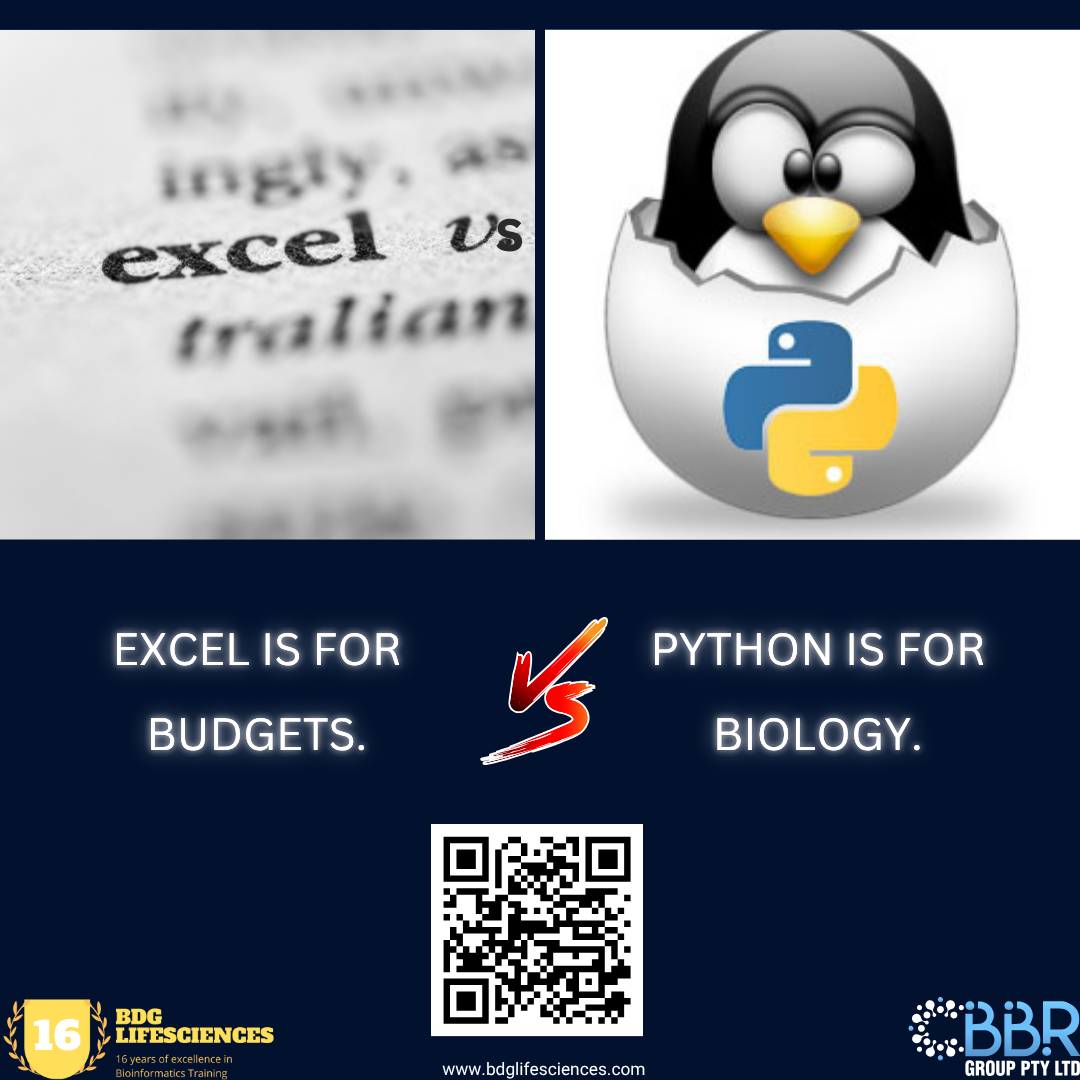
Excel is great for budgets, but it was never designed for the complexity of the human genome. Beyond the frequent crashes, Excel is prone to manual "copy-paste" errors and, famously, has even renamed human genes (like SEPT6 becoming September 6). In a high-stakes clinical environment, these aren't just inconveniences—they are liabilities.
The Python Power-Stack for 2026:
To transition from a "Data Consumer" to a "Data Architect," these are the 4 libraries we recommend mastering this year:
Polars (The Speed Demon): While Pandas was the king for a decade, Polars has become the 2026 standard for high-performance data processing. It handles billions of rows of sensor or genomic data on a standard laptop without breaking a sweat.
BioPython: This remains the "Swiss Army Knife" for biologists. Whether you need to transcribe DNA sequences, parse complex biological file formats, or access the NCBI databases programmatically, BioPython is your foundation.
PyTorch: As generative AI moves into everyday research, PyTorch has become the bedrock for scientists fine-tuning Small Language Models (SLMs) for medical compliance or protein folding.
Streamlit: Want to show your results to a non-coding PI? Streamlit allows you to turn a Python script into an interactive web app in minutes, making your data accessible to everyone.
Reproducibility: The Gold Standard
The most significant advantage of Python isn't speed—it's reproducibility. A Python script is a permanent record of every filter, calculation, and visualization you performed. When it’s time to publish or audit a clinical trial, you don’t have to "remember" what you did in a spreadsheet; you simply run the code.
At BDG Lifesciences, we believe coding is the new "microscope." It’s the tool that allows you to see the patterns hidden in the noise of big data.
Ready to move beyond the spreadsheet? Follow BDG Lifesciences for our upcoming "Python for Biologists" bootcamp and start automating your research today.