More
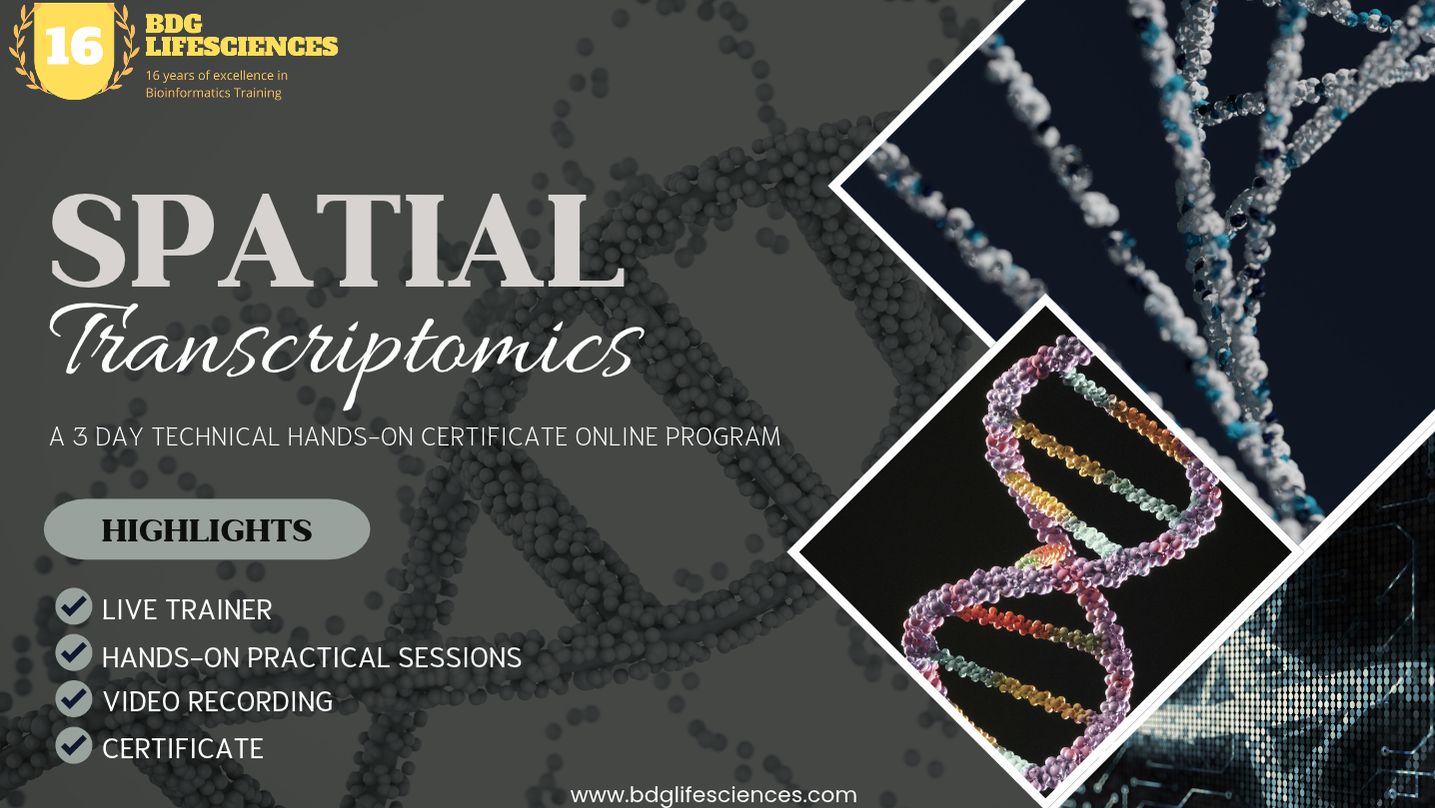
Spatial Transcriptomics Workshop
Understand Spatial Gene Expression, Tissue Architecture and Spatial Data Analysis
4.7

This Event Includes
- High demand video
- Learn from Experts
- Hands-on practical sessions
- Certificate on completion
Registration Fee |
|
In US $ |
$ 96 |
In Indian Rupees |
₹ 8874 |
3 daysSpatial transcriptomics workshop |
90 minPer day |
4.5 hrsTotal workshop duration |
2Hands-on sessions (Days 2 and 3) |
Three-Day Spatial Transcriptomics Workshop: Understanding Gene Expression in Tissue Context
The Three-Day Spatial Transcriptomics Workshop by BDG Lifesciences introduces the scientific principles, technologies, experimental considerations, and computational approaches involved in spatial transcriptomics. The programme covers major spatial technology approaches, including Visium and imaging-based methods, followed by an introduction to spatial data processing, quality control (QC), visualisation, and interpretation.
Spatial transcriptomics is a set of technologies that enables researchers to study gene expression while retaining information about the spatial organisation of cells within tissue samples. Unlike conventional gene expression analysis, which may not preserve the original tissue location of individual expression measurements, spatial transcriptomics connects molecular expression profiles with tissue architecture.
Gene expression analysis provides valuable information about the molecular activity of cells. However, understanding which genes are expressed is only one part of interpreting biological systems. Knowing where that expression occurs within a tissue, how cells are spatially organised, and how different tissue regions relate to one another adds another important dimension to biological research. This spatial information is particularly relevant to researchers investigating tissue biology, cellular organisation, and the distribution of gene expression across different tissue regions.
Across three days, participants progress from understanding why spatial context matters and how spatial studies are designed to recognising spatial data formats, visualising gene expression in tissue context, and interpreting spatial domains and cell-type distributions. The workshop also introduces important concepts such as image alignment, spot/cell segmentation, expression matrices, spatial domains, neighborhood analysis, cell-type mapping, and the relationship between spatial transcriptomics and single-cell RNA sequencing (scRNA-seq).
The programme includes practical exposure through hands-on spatial gene expression and tissue-region visualisation on Day 2, followed by hands-on interpretation of spatial patterns through a case study on Day 3. By connecting biological principles with computational concepts and practical visualisation, this spatial transcriptomics training programme provides students, researchers, and bioinformaticians with an introduction to understanding gene expression in its tissue-specific context.
Workshop Dates
7 to 9 December, 2026. Live trainer will take online sessions from 8:30 PM - 10 PM India time +5:30 GMT on Zoom
Workshop Quick Facts
|
Workshop |
|
|
Duration |
|
|
Technologies covered |
|
|
Hands-on sessions |
|
|
Expected outputs |
|
|
Software and resources |
|
|
Recommended background |
Workshop Overview: Three Days from Principles to Integrated Interpretation
The Three-Day Spatial Transcriptomics Workshop follows a structured progression through the major stages of understanding and interpreting spatial gene expression data. The first day establishes the scientific foundation, introduces spatial technologies, and discusses the considerations involved in designing spatial transcriptomics studies. The second day focuses on spatial data processing, quality control, and visualisation. The final day introduces spatial pattern analysis and integrated interpretation, including the relationship between spatial transcriptomics and scRNA-seq. Each day combines scientific explanations with relevant examples and practical learning activities.
|
01 · Day 1 · 90 min |
→ |
02 · Day 2 · 90 min |
→ |
03 · Day 3 · 90 min |
Day-by-Day Schedule: Spatial Transcriptomics Principles, Data and Interpretation
Day 1: Principles, Technologies and Study Design
|
The first day introduces the fundamental principles of spatial transcriptomics and explains why retaining spatial information is important when studying gene expression in biological tissues. Participants are introduced to the applications of spatial transcriptomics and the biological questions that can be investigated using spatially resolved gene expression information. The session examines two broad technology approaches, Visium and imaging-based methods, and their resolution and trade-offs, followed by experimental considerations including tissue handling, imaging, experimental design, and metadata. The day concludes with an example tissue image and spatial dataset walkthrough. |
90minutes |
Day 1 Session Structure
|
20 min |
Why spatial context matters; applications and key biological questions |
|
||
|
30 min |
Platforms: Visium and imaging-based methods; resolution and trade-offs |
|
||
|
25 min |
Tissue handling; imaging; experimental design; metadata |
|
||
|
15 min |
Example tissue image and spatial dataset walkthrough |
|
|
What this day establishes: An understanding of the scientific principles, technology approaches, and study-design considerations that form the foundation of spatial transcriptomics research. |
Day 2: Data Processing, QC and Visualization
|
The second day focuses on understanding how spatial transcriptomics data is organised, processed, assessed, and visualised. Understanding how image alignment, spot/cell segmentation, and expression matrices fit together is important for interpreting spatial datasets, and spatial quality control, normalization, and common technical artifacts explain why data quality needs to be considered before interpreting gene expression patterns. The practical component focuses on visualising spatial gene expression and tissue regions, giving hands-on exposure to connecting expression information with the corresponding tissue context. The session concludes with interpretation and troubleshooting. |
90minutes |
Day 2 Session Structure
|
25 min |
Image alignment; spot/cell segmentation; expression matrices |
|
||
|
20 min |
Spatial quality control; normalization; common technical artifacts |
|
||
|
35 min |
HANDS-ON: Visualise spatial gene expression; visualise tissue regions |
|
||
|
10 min |
Interpretation; troubleshooting |
|
|
What this day establishes: Familiarity with the organisation and quality considerations of spatial data, along with practical exposure to visualising spatial gene expression and tissue regions. |
Day 3: Spatial Patterns and Integrated Interpretation
|
The third day focuses on understanding spatial patterns and interpreting gene expression in relation to tissue organisation. Participants are introduced to spatial domains, neighborhood analysis, and cell-type mapping, and to the relationship between spatial transcriptomics and single-cell RNA sequencing (scRNA-seq), including deconvolution and ligand–receptor concepts. The practical component involves interpreting spatial patterns in a case study, an opportunity to examine spatial information in a biological context. The final part of the session addresses limitations and reproducibility, followed by questions and next steps. |
90minutes |
Day 3 Session Structure
|
25 min |
Spatial domains; neighborhood analysis; cell-type mapping |
|
||
|
25 min |
Integration with scRNA-seq; deconvolution; ligand–receptor concepts |
|
||
|
25 min |
HANDS-ON: Interpret spatial patterns in a case study |
|
||
|
15 min |
Limitations; reproducibility; questions and next steps |
|
|
What this day establishes: An understanding of spatial patterns, cell-type distributions, and integrated interpretation, supported by practical case study interpretation. |
Workshop at a Glance: Time and Hands-On Practice
Time per Day
Each of the three days is 90 minutes, so every day is one third of the 270-minute (4.5-hour) workshop.
|
Day 1 |
Day 2 |
Day 3 |
Three-Stage Workflow and Key Spatial Transcriptomics Concepts Explained
The Three-Day Spatial Transcriptomics Workshop follows three connected stages. Each stage builds on the understanding developed in the previous one, moving from the scientific principles of spatial transcriptomics to spatial data visualisation and interpretation.
|
Stage 1 |
→ |
Stage 2 |
→ |
Stage 3 |
Stage 1: Principles and Technologies
|
Stage 2: Data Processing, Quality Control and Visualisation
|
Stage 3: Spatial Patterns and Integrated Interpretation
|
Expected Practical Outputs of the Spatial Transcriptomics Workshop
The programme is designed around three expected outputs:
|
1. Spatial Expression Maps |
2. Tissue-Domain Visualizations |
3. Interpretation Summary |
||
These outputs reflect the practical direction of the programme and its emphasis on understanding, visualising, and interpreting spatial transcriptomics information.
Who Should Attend the Spatial Transcriptomics Workshop?
The workshop is designed for individuals interested in understanding gene expression in relation to tissue architecture, spatial organisation, and cellular distribution. It is particularly relevant to the following groups.
|
|
Recommended background: Basic transcriptomics knowledge is helpful for following the scientific and computational concepts discussed during the workshop. The programme is structured as an introduction to spatial transcriptomics principles, technologies, data processing, visualisation, and interpretation. |
Why You Should Attend
Gene expression data provides information about molecular activity, but its spatial context can add important biological information. This workshop introduces the principles and computational considerations involved in understanding gene expression within its original tissue environment.
|
How the Spatial Transcriptomics Workshop Can Help Your Career
Spatial transcriptomics is relevant to research areas where understanding gene expression alongside tissue organisation is important. As spatial technologies generate information connecting molecular expression with tissue architecture, researchers and bioinformaticians need to understand both the biological context and the computational considerations involved in interpreting these datasets. The workshop introduces concepts that may support participants working or planning to work in related research areas.
|
For postgraduate students, researchers, and bioinformaticians, understanding spatial transcriptomics can provide useful scientific and computational context when exploring research involving tissue architecture, spatial gene expression, and cellular organisation. The workshop is an introductory training programme. It provides familiarity with the specified technologies, data concepts, visualisation activities, and interpretation approaches rather than claiming independent proficiency across all spatial transcriptomics platforms or analytical workflows.
Why Choose BDG Lifesciences for This Workshop?
|
The workshop follows a structured approach that connects the biological and computational aspects of spatial transcriptomics without separating the data from the tissue context in which it originates. For students, researchers, and bioinformaticians interested in spatial biology, BDG Lifesciences provides a training environment focused on understanding the scientific concepts and computational considerations relevant to this field.
Registration Fee
Simple, Transparent Pricing
One fee for all participants. No hidden charges. Includes live sessions, session recordings, and completion certificate.
$ 96 US Dollars — For all participants across the world | Click here to Register
Registration is non-refundable and non-transferable. Please read the full T&C below before registering.
Frequently Asked Questions About the Spatial Transcriptomics Workshop
What is spatial transcriptomics?
Spatial transcriptomics is a group of technologies used to study gene expression while retaining information about where that expression occurs within a tissue. It connects molecular expression data with tissue architecture and spatial cell organisation, helping researchers examine gene expression in its biological context.
What will I learn in the Three-Day Spatial Transcriptomics Workshop?
The workshop covers spatial transcriptomics principles, Visium and imaging-based methods, tissue handling, experimental design, spatial data processing, quality control, visualisation, and interpretation. Participants also gain hands-on exposure to spatial gene expression visualisation and interpreting spatial patterns through a case study.
Why is spatial context important in gene expression analysis?
Gene expression can differ across tissue regions and cellular environments. Retaining spatial information helps researchers understand where particular expression patterns occur and how they relate to tissue architecture and cellular organisation.
Which spatial transcriptomics platforms are covered in this workshop?
The workshop introduces Visium and imaging-based spatial transcriptomics methods. It also discusses resolution and technology trade-offs to help participants understand the characteristics of these approaches.
What is the difference between Visium and imaging-based spatial transcriptomics methods?
Visium and imaging-based methods represent different approaches to obtaining spatially resolved gene expression information. The workshop introduces both approaches and discusses their resolution and trade-offs rather than treating them as identical technologies.
Why is resolution important in spatial transcriptomics?
Resolution determines the spatial level at which gene expression information can be examined. Understanding resolution and its associated trade-offs is important when comparing spatial technologies and interpreting the information they provide.
What are spot/cell segmentation and expression matrices?
Spot/cell segmentation concerns identifying spatial units associated with measurements in a tissue. Expression matrices provide structured representations of gene expression information. Both concepts are important for understanding how spatial transcriptomics data is organised and interpreted.
What is spatial quality control, and why is it important?
Spatial quality control involves assessing the quality and characteristics of spatial transcriptomics data. It helps researchers recognise technical issues and artifacts that may affect the interpretation of spatial gene expression patterns. The workshop also introduces normalization and common technical artifacts.
How is spatial gene expression visualised in tissue sections?
Spatial gene expression can be represented visually by associating gene expression measurements with their corresponding tissue locations. This allows researchers to examine expression patterns in relation to tissue regions and architecture. The workshop includes a hands-on session covering spatial gene expression and tissue-region visualisation.
What are spatial domains and neighborhood analysis?
Spatial domains are distinguishable regions within a tissue that can be examined in relation to spatial gene expression and organisation. Neighborhood analysis concerns spatial relationships between nearby locations or cells. Both concepts contribute to understanding how tissue regions and cellular distributions are organised.
How is spatial transcriptomics integrated with scRNA-seq?
Spatial transcriptomics and single-cell RNA sequencing provide complementary information. Spatial transcriptomics retains tissue-location information, while scRNA-seq provides gene expression information at the single-cell level. The workshop introduces their integration, along with deconvolution and ligand–receptor concepts, as part of integrated interpretation.
What practical outputs can participants expect from the workshop?
The expected outputs include spatial expression maps, tissue-domain visualizations, and an interpretation summary. These outputs reflect the programme’s practical focus on spatial gene expression visualisation and interpretation.
Who should attend this spatial transcriptomics training programme?
The workshop is intended for researchers interested in tissue biology, postgraduate students, and bioinformaticians. Individuals from related disciplines such as molecular biology, biotechnology, genetics, genomics, transcriptomics, and computational biology may also find the programme relevant.
Is prior transcriptomics knowledge required?
Basic transcriptomics knowledge is helpful for following the concepts discussed during the workshop. The programme introduces spatial transcriptomics principles, technologies, data processing, visualisation, and interpretation.
Which software environments and resources are mentioned?
The workshop specifies a laptop with an R/RStudio or Python environment. Seurat and Squidpy are mentioned as example software. A prepared spatial dataset, histology image, and metadata are also specified as resources.
Which topics are covered through hands-on activities?
There are two explicitly identified hands-on sessions. Day 2 covers visualisation of spatial gene expression and tissue regions, while Day 3 covers interpretation of spatial patterns in a case study. Day 1 includes an example tissue image and spatial dataset walkthrough.
How long is the Spatial Transcriptomics Workshop?
The workshop runs for three days, with approximately 90 minutes of instruction per day. The total scheduled duration is 4.5 hours.
How is spatial transcriptomics relevant to research?
Spatial transcriptomics allows researchers to examine gene expression in relation to tissue architecture and cellular organisation. Understanding spatial domains, cell-type distributions, and spatial expression patterns can be relevant to research involving tissue biology, transcriptomics, genomics, and computational biology.
Registration
How To Register
Secure your spot in 3 simple steps — seats are limited for each batch.
1️⃣ Click Register Now- Click the Register Now button and select number of tickets you want to buy..
2️⃣ Check Your Confirmation Email- After successful payment, check your email for a confirmation with registration details and next steps.
3️⃣ Receive Your Zoom Link- Once registration closes, you'll receive the Zoom meeting link and be added to the workshop WhatsApp group.
📧 Need help? Email us at workshops@bdglifesciences.com or chat with our AI Assistant George at bdglifesciences.com
T & C
- The Registration and Participation Fee is same for all participants irrespective of their location.
- Please provide a GMAIL ID for registration as the recorded video session will be provided on YouTube. Kindly provide that email ID by which you use YouTube.
- Video recording of each session will be provided at the end of the session to give the user a unique learning experience.
- Interactive training sessions will be conducted on Google Meet/Zoom so to give users a better learning experience.
- As it is with a LIVE TRAINER hence practical application, i.e., the experiments/tasks to be performed can be done in the best explainable manner.
- In this Online Workshop, there will be a LIVE trainer who will solve queries along with training.
- The program is SELF-PACED. After each session video of that particular session will be shared with you so you can go through as many times as you want and perfect yourself in the topics & tasks.
- If you miss any session then NO PROBLEM you can still perform the tasks by going through the video of that particular session.
- Make sure you register under the right category. If you register under the wrong category then your registration will be invalid and NO REFUND WILL BE MADE IN THIS CASE. This is your mistake and the company is not responsible for it.
- To avoid this do read the description of the ticket before selecting and proceeding with payment.
- You need to upload your professional ID which can be your Student ID Card or Research Institute ID Card or Company ID Card. DO NOT UPLOAD EXPIRED ID OR ANY GOVERNMENT ID LIKE AADHAR, PAN, you have to upload professional ID.
- If you are currently not employed or not studying, you may upload the professional ID from your previous affiliation (degree or company), provided you are registering under the correct category. If you are in India, or will be in India at the time of the workshop or training or research project, your category will be Participants in India, and you can upload any valid ID (including one from your previous affiliation). If, at the time of the workshop or training or research project, you are not in India, your category will be Participants outside India, and you can upload any valid ID.
- After registration, you will join the workshop's WhatsApp group. If you have registered in the "Participants in India" category, you must join using an Indian phone number only.
- The certificate will be issued as per the details which you provide in the registration form while registering before payment.
- Once you register relax we will send you the meeting link after the workshop registration gets over.
- We want to make sure that you learn properly hence the training certificate will be given ONLY on successful completion of all the tasks given by the trainer.
- The certificates of all our Online programs are sent by email(softcopy) which has a unique barcode. You can take a print of that on heavy cardstock or photo paper and get it laminated if required.
- The registration is NON-REFUNDABLE and NON-TRANSFERABLE.
- BDG Lifesciences reserves the right of admission in all our programs.
- If you are removed or your registration is canceled then there will be no answer to that. We have our own reasons for such an act of ours
- If we do not wish to give this workshop to any participant then we will refund their amount.
- You should also read the Terms & Conditions page as well as the FAQs page. For any assistance kindly chat with our AI Assistant George on the website www.bdglifesciences.com.
BDG LifeSciences
BDG LifeSciences is a distinguished bioinformatics company established in 2010 and operates globally. Headquartered in India, the company specializes in facilitating workshops, training programs, novel and innovative research projects, and online courses in bioinformatics and life sciences. BDG LifeSciences is registered under the Ministry of MSME (Micro, Small, and Medium Enterprises), Government of India, with the registration number UDYAM-UP-01-0019151. In January 2024, BDG LifeSciences, India, has authorized BBR Group Pty Ltd., Australia (ACN 608 550 849), to operate its programs in Australia and New Zealand.
With a strong focus on the practical application of technology, BDG LifeSciences provides hands-on training where participants work on their own computers/laptops using specialized software and servers. The company has been a leader in this sector for the last 16 years, successfully educating a diverse range of participants, including students, scientists, faculty members, professors, and corporate executives worldwide.
Programs
Related Workshops
- WGS Analysis Workshop
- NGS Healthcare Workshop
- Transcriptomics Workshop
- Bioinformatics Workshop
- Drug Discovery & Design
Company
- About Us
- Publications
- Advisors & Collaborators
- Blogs
- Careers
- FAQs
- Terms & Conditions
- Privacy Policy
- Contact Us
© 2026 BDG Lifesciences. All Rights Reserved. | 16+ Years of Bioinformatics Excellence | Trusted by 2,000+ Participants in 40+ Countries Privacy Policy · Terms & Conditions
Recommended Just for You