More
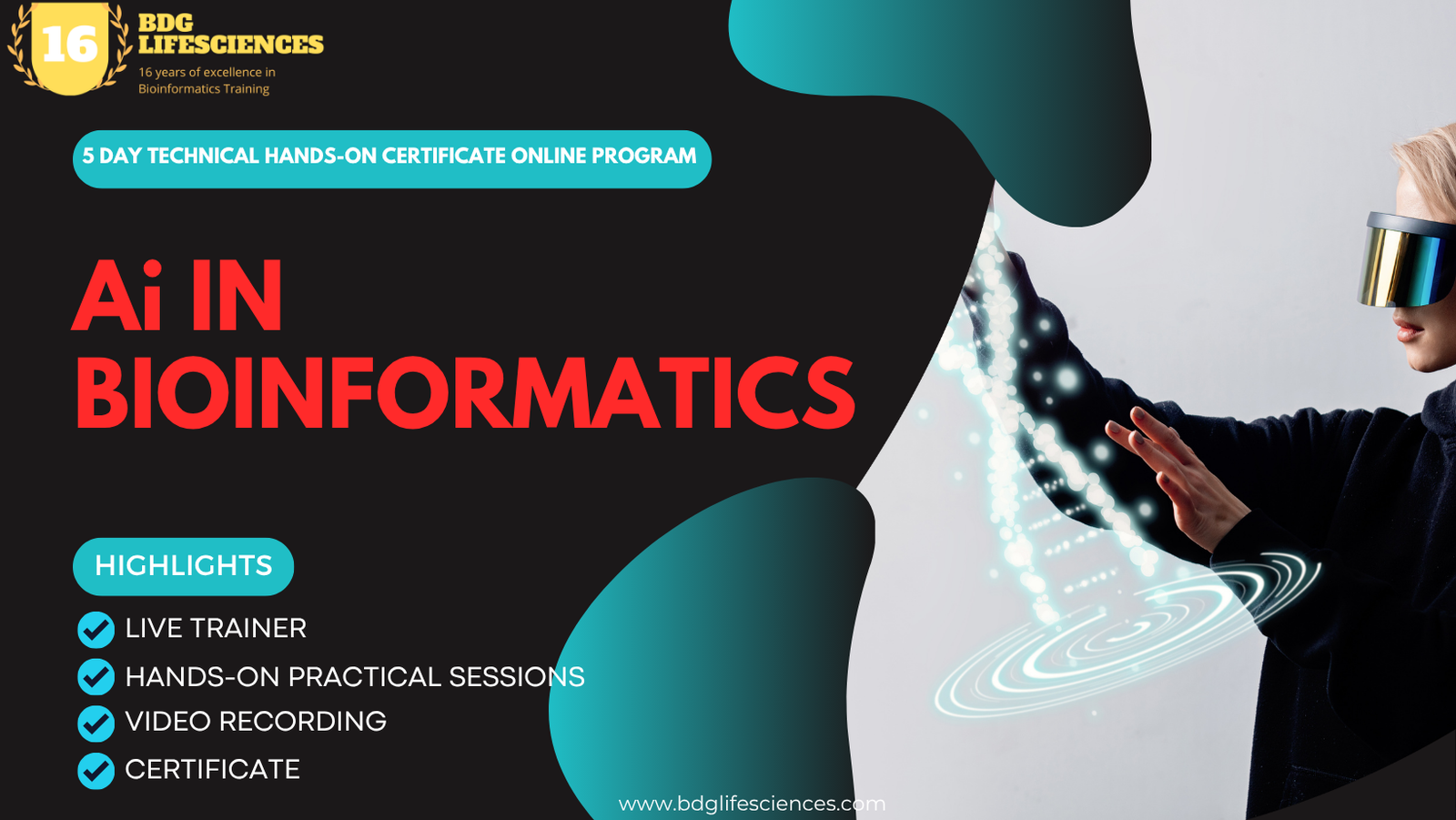
AI in Bioinformatics
Learn Python, BioPython, QSAR modelling, machine learning with WEKA, drug binding modelling and more. Live trainer. Certificate on completion. Register Now.
4.7
This Event Includes
- High demand video
- Learn from Experts
- Hands-on practical sessions
- Certificate on completion
Registration Fee |
|
In US $ |
$ 149 |
In Indian Rupees |
₹ 13990 |
What is This AI in Bioinformatics Workshop?
Artificial Intelligence is no longer a separate discipline that biologists occasionally hear about at conferences. It is now embedded at the heart of how modern life sciences research is conducted — from predicting protein structures and analysing genomic sequences, to building QSAR models that predict the biological activity of drug candidates and training machine learning algorithms that identify patterns in molecular data that no human researcher could detect manually.
Yet the majority of students, researchers, and professionals in bioinformatics, biotechnology, pharmacy, and life sciences have never received practical, guided training in how to use AI and Python-based tools for biological research. They know these skills exist and that they are in demand. They have never sat down, opened a Jupyter Notebook or Google Colab, and actually built and validated a machine learning model on a real biological dataset — with an expert walking them through every step.
BDG LifeSciences — established in 2010, MSME-registered under the Government of India, and globally authorised to operate in Australia and New Zealand via BBR Group Pty Ltd — has been delivering expert-led, hands-on bioinformatics training for over 16 years. We are proud to present our 5-Day Technical Hands-On Certificate Online Workshop in AI in Bioinformatics — a practical, application-driven programme that covers Python for bioinformatics, BioPython, QSAR modelling and machine learning pipelines using WEKA and PaDEL, model building using linear regression and random forest, model evaluation, and drug binding modelling using Python.
Each session runs for 2 hours live on Zoom, delivered by expert trainer Sharvari Kulkarni, CTO of BDG LifeSciences. Participants work on their own computers using Google Colab, Jupyter Notebook, WEKA, PaDEL, and ChemSketch — real tools used in published research. Session recordings are shared after every class. A Certificate of Completion with a unique verification barcode is awarded on successfully completing all assigned tasks.
Whether you are a student who has never opened a Python environment before, or a researcher who wants to formalise and expand your computational and AI skills into drug discovery and QSAR modelling — this programme gives you a complete, structured, expert-guided foundation in 5 focused days.
Workshop Dates
26 to 30 September, 2026. Live trainer will take online sessions from 8 AM - 9:30 AM India time (+5:30 GMT) time on Zoom.
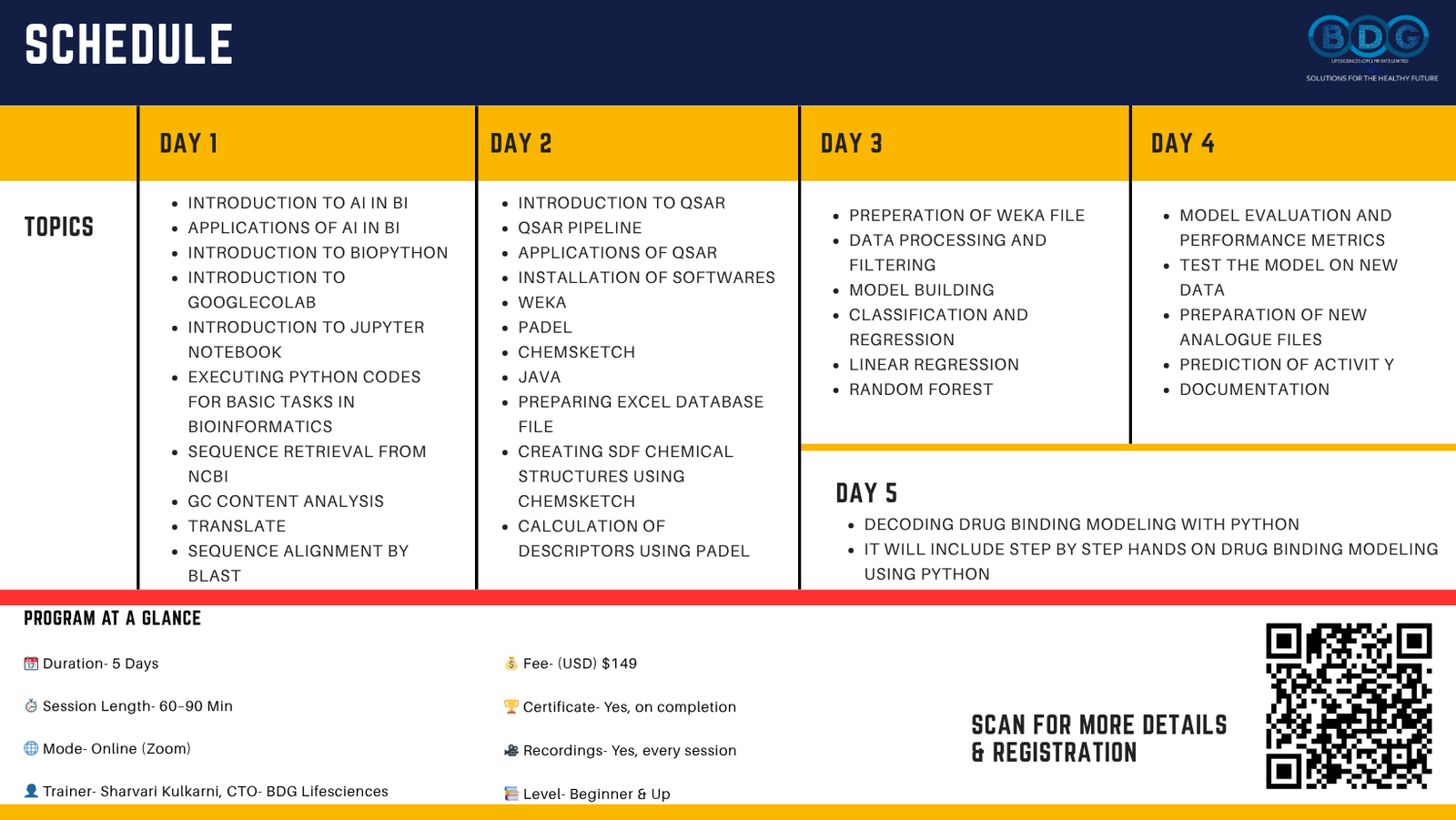
5-Day AI in Bioinformatics Workshop — Day-by-Day Curriculum
A structured 5-day programme that progresses from Python and AI fundamentals in bioinformatics, through QSAR pipeline construction and machine learning model building, to model evaluation, prediction of biological activity, and advanced drug binding modelling using Python.
▶ PHASE 1 — Python & AI Foundations in Bioinformatics (Day 1)
|
DAY 01 — Introduction to AI in Bioinformatics & Python Fundamentals
📌 Learning Outcome: Use Python in Google Colab and Jupyter Notebook to retrieve sequences from NCBI, perform GC content analysis, translate sequences, and run BLAST alignments programmatically |
▶ PHASE 2 — QSAR Pipeline & Data Preparation (Days 2–3)
|
DAY 02 — Introduction to QSAR & Dataset Preparation
📌 Learning Outcome: Understand the QSAR pipeline, install all required tools, build a compound dataset, draw chemical structures in ChemSketch, and calculate PaDEL molecular descriptors |
|
DAY 03 — WEKA File Preparation, Data Processing & Machine Learning Model Building
📌 Learning Outcome: Prepare WEKA datasets, apply data filtering, and build Linear Regression and Random Forest models for biological activity prediction |
▶ PHASE 3 — Model Evaluation, Prediction & Documentation (Day 4)
|
DAY 04 — Model Evaluation, New Compound Prediction & Documentation
📌 Learning Outcome: Evaluate QSAR model performance, apply the model to predict activity of new analogues, and document the complete workflow for research and publication use |
▶ PHASE 4 — Drug Binding Modelling with Python (Day 5)
|
DAY 05 — Drug Binding Modelling with Python
📌 Learning Outcome: Perform a complete drug binding modelling workflow using Python — from structure preparation to binding result interpretation — applicable to drug discovery research |
🔨 Tools & Platforms Used in This Workshop
|
Python Core programming language |
BioPython Biological sequence analysis |
Google Colab Cloud Python environment |
Jupyter Notebook Interactive coding environment |
|
WEKA Machine learning platform |
PaDEL-Descriptor Molecular descriptor calculation |
ChemSketch Chemical structure drawing |
NCBI & BLAST Sequence retrieval & alignment |
Why You Should Attend This AI in Bioinformatics Workshop
AI and machine learning are reshaping every area of bioinformatics, drug discovery, and life sciences research. Here is exactly why this 5-day programme will fundamentally upgrade your skills, research capabilities, and career prospects:
|
Learn Python for Biology — No Programming Background Needed Day 1 assumes zero Python experience. The trainer walks you through Google Colab and Jupyter Notebook from scratch, executing real biological tasks — retrieving sequences from NCBI, calculating GC content, translating nucleotide sequences, and running BLAST — all in Python. By the end of Day 1, you will have written and run Python code that performs real bioinformatics analysis. |
Build & Validate Real Machine Learning Models for Drug Discovery Days 2–4 take you through the complete QSAR pipeline — drawing chemical structures in ChemSketch, calculating molecular descriptors in PaDEL, building Linear Regression and Random Forest models in WEKA, evaluating model performance, and predicting the biological activity of new drug analogues. This is the exact workflow used in published QSAR research papers and pharmaceutical R&D. |
|
Master Drug Binding Modelling Using Python Day 5 covers one of the most in-demand skills in computational drug discovery — drug binding modelling using Python. You will perform a complete, step-by-step workflow: preparing protein and ligand structures, running binding calculations, and interpreting the results. This skill is directly applicable to protein-ligand interaction studies, drug target validation, and computational screening workflows. |
Outputs You Can Use Directly in Research & Publications Every deliverable produced in this workshop — QSAR model performance reports, activity prediction tables for new analogues, Python scripts for sequence analysis, and drug binding results — is directly usable in your thesis, dissertation, or journal submission. These are standard components of computational biology and drug discovery publications. |
|
Build Career-Defining Skills in the Fastest-Growing Field in Life Sciences AI and machine learning in bioinformatics and drug discovery are among the most sought-after skills in pharmaceutical, biotech, and research job markets globally. Employers are not just looking for biologists — they are looking for biologists who can code, build models, and interpret AI-driven results. This certificate proves you can do exactly that. |
Verified Certificate — A Credible, Barcoded Credential Participants who successfully complete all tasks receive a BDG LifeSciences Certificate of Completion carrying a unique barcode for independent verification — recognized by academic institutions and employers across India, Australia, New Zealand, and internationally. Add it to your LinkedIn, portfolio, university application, or CV immediately. |
|
Session Recordings — Revisit Every Line of Code Every session is recorded and shared with all participants after class via YouTube. Python coding and machine learning workflows benefit enormously from repetition — with recordings you can pause, rewind, and re-run every step until the code works and the concept is clear. |
No Specialised Hardware or Institutional Server Access Required All Python sessions use Google Colab — a free, cloud-based environment that runs entirely in your browser with no installation. WEKA, PaDEL, and ChemSketch are freely downloadable. You need nothing more than a laptop with a stable internet connection. No high-performance computing, no institutional VPN, no paid software licenses. |
Who Should Attend This AI in Bioinformatics Workshop?
This workshop is designed for anyone in life sciences, biotechnology, pharmacy, or computational biology who wants to learn how to apply AI, machine learning, and Python to real biological research problems. No prior programming or AI experience is required.
|
🎓 Students B.Sc., M.Sc., Ph.D., MBBS, M.Pharm students in Bioinformatics, Biotechnology, Biochemistry, Pharmacy, Pharmaceutical Chemistry, Life Sciences, Genetics, Biomedical Sciences, and related disciplines who want to add AI and Python skills to their academic profile |
💬 Researchers & Faculty Research scholars, post-doctoral researchers, faculty, and professors who want to incorporate AI-driven QSAR modelling, Python-based sequence analysis, and drug binding modelling into their research workflows, publications, and grant proposals |
🏭 Industry Professionals Scientists, bioinformatics analysts, computational biologists, and professionals in pharmaceutical R&D, biotech companies, CROs, genomics firms, and regulatory agencies who need practical AI and machine learning competencies for drug discovery and data-driven research |
|
💊 Drug Discovery Scientists Medicinal chemists, pharmacologists, and drug discovery researchers who want to build QSAR models for activity prediction, use Python for drug binding analysis, and apply machine learning to accelerate lead identification and optimisation |
👔 Wet-Lab Biologists Transitioning to Computation Experimental biologists who want to complement their wet-lab expertise with Python programming, AI modelling, and computational drug discovery skills — enabling them to independently perform in silico analyses and reduce dependence on separate computational teams |
🌟 Complete Beginners to Python & AI Anyone in life sciences who knows that Python, AI, and machine learning are essential future skills but has never known where to start. Day 1 begins from zero — no prior programming, no prior AI knowledge, and no mathematics beyond what any life sciences graduate already knows |
Your Expert Trainer
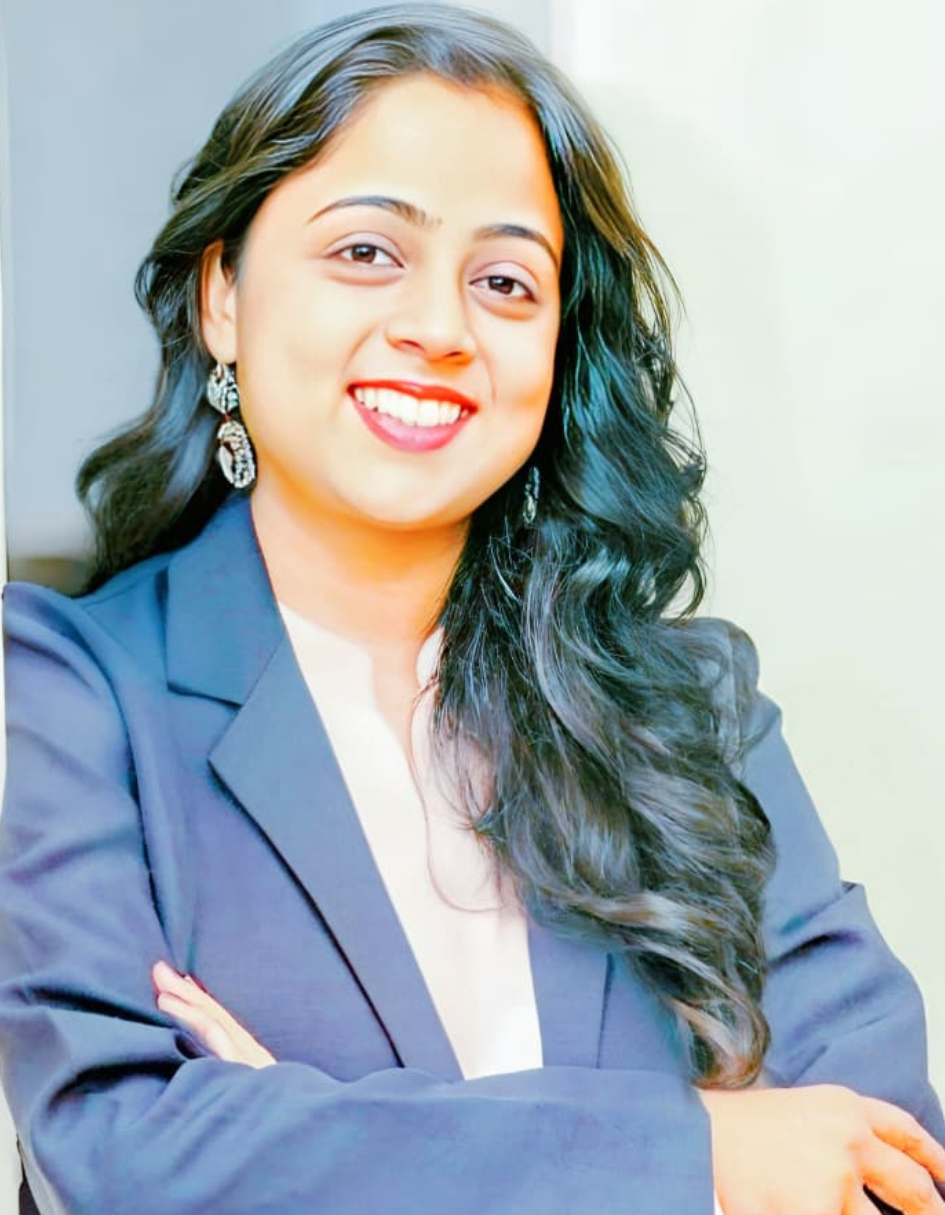
Resource PersonSharvari KulkarniCTO, BDG LifeSciences | Bioinformatics & Computational Drug Design Expert Sharvari Kulkarni is one of India's most respected bioinformatics trainers and a leading expert in computational drug design, AI-driven drug discovery, QSAR modelling, molecular simulations, molecular docking, and network pharmacology. As Chief Technology Officer of BDG LifeSciences, she leads the technical training division and has personally trained hundreds of participants globally — consistently receiving over 90% positive feedback across all programmes for her structured, patient, and deeply practical teaching approach. Her expertise spans the complete spectrum of computational biology and AI applications in life sciences — from Python-based bioinformatics workflows and QSAR pipeline development, through machine learning model building with WEKA and drug binding modelling, to MD simulations using GROMACS and Schrödinger's Desmond Maestro on both Windows and Linux platforms. She is the only trainer at BDG LifeSciences conducting hands-on AI and QSAR modelling training specifically for life sciences participants, making complex machine learning concepts genuinely accessible to researchers with no prior programming background. With over 15 research papers published in reputable peer-reviewed journals, Sharvari actively guides student research projects, serves on academic and industry panels, and speaks on international computational biology and AI platforms. Her workshops are known for combining rigorous scientific content with step-by-step practical instruction — ensuring participants at every level leave with real, applicable skills.
|
Why Choose BDG LifeSciences for AI in Bioinformatics Training?
With 16+ years, 10000+ workshops, and participants trained across 40+ countries — here is why BDG LifeSciences is the most trusted choice for practical AI and bioinformatics education globally.
|
16+ Years of Bioinformatics Training Excellence Since 2010, BDG LifeSciences has delivered hands-on, practical bioinformatics and computational biology training to participants across 40+ countries — with a consistent 4.7/5 participant rating. We have been integrating AI and machine learning into our bioinformatics curriculum since before it became mainstream, making us uniquely qualified to teach it in a life sciences context. |
Live Trainer — Real-Time Guidance on Every Tool & Every Line of Code Python, WEKA, and drug binding workflows are best learned with an expert present in real time — to explain errors, demonstrate correct outputs, and answer questions the moment they arise. Every session in this workshop is delivered live by Sharvari Kulkarni. You get immediate help when your code does not run and real-time explanation when model results need interpretation. |
|
AI Made Accessible for Life Scientists — Not Just Computer Scientists Most AI and machine learning courses are built for computer science students. This workshop is built specifically for life scientists — using biological datasets, pharmaceutical compounds, and drug discovery applications as the context for every AI tool and Python script. The terminology, the examples, and the outputs are all grounded in biology, not abstract data science. |
Globally Trusted & Officially Registered MSME-registered under the Government of India (UDYAM-UP-01-0019151) and officially authorised to operate in Australia and New Zealand via BBR Group Pty Ltd (ACN 608 550 849). Our certificates carry a unique verification barcode and are recognized by academic institutions and employers across India, Australia, New Zealand, and internationally. |
|
From Zero to QSAR Model in 5 Days The 5-day structure is specifically designed so that a participant who has never written a line of Python or used WEKA on Day 1 walks away on Day 5 having built, validated, and applied a complete QSAR machine learning model — and performed drug binding modelling using Python. This is one of the most complete AI in bioinformatics programmes available at this price and duration. |
Verified Certificate for Your Academic & Professional Profile Every participant who successfully completes all tasks receives a BDG LifeSciences Certificate of Completion with a unique barcode for independent verification. It is issued as a professional digital softcopy via email — printable, shareable on LinkedIn, and accepted by academic institutions and employers internationally as a credible, trainer-assessed credential. |
Registration Fee
Simple, Transparent Pricing
One fee for all participants. No hidden charges. Includes live sessions, session recordings, and completion certificate.
$ 149 US Dollars — same for all participants | Register Now →
Registration is non-refundable and non-transferable. Please read the full T&C below before registering.
Registration
How To Register
Secure your spot in 3 simple steps — seats are limited for each batch.
1️⃣ Click Register Now- Click the Register Now button and select number of tickets you want to buy..
2️⃣ Check Your Confirmation Email- After successful payment, check your email for a confirmation with registration details and next steps.
3️⃣ Receive Your Zoom Link- Once registration closes, you'll receive the Zoom meeting link and be added to the workshop WhatsApp group.
📧 Need help? Email us at workshops@bdglifesciences.com or chat with our AI Assistant George at bdglifesciences.com
Frequently Asked Questions — AI in Bioinformatics Workshop
|
Q. What exactly is covered in this 5-day AI in Bioinformatics workshop? This workshop covers four structured phases: Day 1 introduces AI in bioinformatics, BioPython, Google Colab, Jupyter Notebook, and Python-based sequence analysis including NCBI retrieval, GC content, sequence translation, and BLAST. Days 2–3 cover the complete QSAR pipeline — ChemSketch, PaDEL molecular descriptors, WEKA file preparation, data processing, and machine learning model building using Linear Regression and Random Forest. Day 4 covers model evaluation, performance metrics, testing on new data, predicting biological activity of analogues, and documentation. Day 5 covers drug binding modelling using Python — a complete step-by-step hands-on session from structure preparation to result interpretation. |
|
Q. Do I need prior Python or programming experience to attend this workshop? No. Day 1 is specifically designed for participants who have never used Python before. The trainer introduces Google Colab and Jupyter Notebook from scratch and guides you through every line of code step by step. The workshop uses Google Colab — a free, browser-based Python environment — which means there is no complex installation required. All you need is a Gmail account and a stable internet connection. |
|
Q. What is QSAR and why is it important in drug discovery? QSAR stands for Quantitative Structure-Activity Relationship. It is a computational methodology that uses mathematical models to establish a relationship between the chemical structure of a molecule and its biological activity — allowing researchers to predict how active a new compound will be before synthesising it in the laboratory. QSAR is widely used in pharmaceutical R&D for lead identification, toxicity prediction, and compound optimisation. Days 2–4 of this workshop take you through the complete QSAR pipeline — from drawing structures to building, validating, and applying a machine learning QSAR model to predict the activity of new drug analogues. |
|
Q. What software do I need to install for this workshop? For Python sessions (Days 1 and 5), you use Google Colab — which runs entirely in your web browser and requires no installation. You only need a Gmail account. For QSAR sessions (Days 2–4), you will install WEKA (free, open-source machine learning platform), PaDEL-Descriptor (free descriptor calculator), ChemSketch (free chemical structure drawing tool), and Java (required to run WEKA and PaDEL). The trainer guides the installation of all software live on Day 2. All tools are freely available and work on Windows, Mac, and Linux. |
|
Q. What is the difference between Linear Regression and Random Forest in this workshop context? Both are machine learning algorithms used to build QSAR predictive models in this workshop, and both are implemented in WEKA. Linear Regression predicts continuous biological activity values by fitting a straight-line relationship between molecular descriptors and activity — it is interpretable, fast, and widely used in regression QSAR studies. Random Forest is an ensemble method that builds multiple decision trees and aggregates their predictions — it handles non-linear relationships, is more robust to overfitting, and generally produces higher-accuracy predictions on complex biological datasets. Day 3 covers both methods in full, and Day 4 covers how to evaluate and compare their performance using standard metrics. |
|
Q. Are sessions recorded? What if I miss a day? Yes. Every session is recorded and shared with all registered participants after each class via YouTube, using the Gmail ID you provide during registration. If you miss a session, you can still complete all assigned tasks by watching the recording at your own pace. Python and QSAR workflows particularly benefit from recordings — you can pause and rerun every step as many times as needed until the code executes correctly. Please register with the Gmail ID you actively use on YouTube for seamless access. |
|
Q. Will I receive a certificate on completion? Yes. A BDG LifeSciences Certificate of Completion is awarded to every participant who successfully completes all tasks assigned by the trainer across the 5 days. The certificate is issued as a professional digital softcopy via email, carrying a unique barcode for independent verification by employers and academic institutions. You may print it, laminate it, add it to your LinkedIn profile, or include it in job applications and academic submissions. It will be issued exactly as per the name and details provided during registration. |
|
Q. How will this AI in Bioinformatics workshop help my PhD research or publications? This workshop produces research-ready outputs at every stage. Your Python scripts for NCBI sequence retrieval, GC content analysis, and BLAST are directly usable in computational methods sections. Your QSAR model — including descriptor dataset, model performance metrics (R², RMSE), and activity predictions for new analogues — forms the core of a complete computational drug discovery publication. Your drug binding modelling results contribute directly to molecular interaction studies. All of these are standard components of papers in journals covering computational chemistry, bioinformatics, and medicinal chemistry. |
|
Q. What platform will live sessions be conducted on? Live sessions are conducted on Zoom or Google Meet. The Zoom meeting link will be sent to all registered participants after the registration period closes. You will need a stable internet connection, a Gmail account for accessing Google Colab (Day 1 and 5), and the Gmail ID provided during registration to access session recordings on YouTube. |
|
Q. Is the registration fee refundable or transferable? No. The registration fee is non-refundable and non-transferable. Please read the full Terms & Conditions carefully before completing registration and ensure you register under the correct participant category — India or Outside India. Registering under the wrong category will result in cancellation with no refund. BDG LifeSciences reserves the right of admission to all its programmes. |
T & C
- For this event the Fee is same for all participants which is $ 149 US equivalent to 13990 Indian Rupees.
- Please provide a GMAIL ID for registration as the recorded video session will be provided on YouTube. Kindly provide that email ID by which you use YouTube.
- Video recording of each session will be provided at the end of the session to give the user a unique learning experience.
- Interactive training sessions will be conducted on Google Meet/Zoom so to give users a better learning experience.
- As it is with a LIVE TRAINER hence practical application, i.e., the experiments/tasks to be performed can be done in the best explainable manner.
- In this Online Workshop, there will be a LIVE trainer who will solve queries along with training.
- The program is SELF-PACED. After each session video of that particular session will be shared with you so you can go through as many times as you want and perfect yourself in the topics & tasks.
- If you miss any session then NO PROBLEM you can still perform the tasks by going through the video of that particular session.
- Make sure you register under the right category. If you register under the wrong category then your registration will be invalid and NO REFUND WILL BE MADE IN THIS CASE. This is your mistake and the company is not responsible for it.
- To avoid this do read the description of the ticket before selecting and proceeding with payment.
- You need to upload your professional ID which can be your Student ID Card or Research Institute ID Card or Company ID Card. DO NOT UPLOAD EXPIRED ID OR ANY GOVERNMENT ID LIKE AADHAR, PAN, you have to upload professional ID.
- If you are currently not employed or not studying, you may upload the professional ID from your previous affiliation (degree or company), provided you are registering under the correct category. If you are in India, or will be in India at the time of the workshop or training or research project, your category will be Participants in India, and you can upload any valid ID (including one from your previous affiliation). If, at the time of the workshop or training or research project, you are not in India, your category will be Participants outside India, and you can upload any valid ID.
- After registration, you will join the workshop's WhatsApp group. If you have registered in the "Participants in India" category, you must join using an Indian phone number only.
- The certificate will be issued as per the details which you provide in the registration form while registering before payment.
- Once you register relax we will send you the meeting link after the workshop registration gets over.
- We want to make sure that you learn properly hence the training certificate will be given ONLY on successful completion of all the tasks given by the trainer.
- The certificates of all our Online programs are sent by email(softcopy) which has a unique barcode. You can take a print of that on heavy cardstock or photo paper and get it laminated if required.
- The registration is NON-REFUNDABLE and NON-TRANSFERABLE.
- BDG Lifesciences reserves the right of admission in all our programs.
- If you are removed or your registration is canceled then there will be no answer to that. We have our own reasons for such an act of ours
- If we do not wish to give this workshop to any participant then we will refund their amount.
- You should also read the Terms & Conditions page as well as the FAQs page. For any assistance kindly chat with our AI Assistant George on the website www.bdglifesciences.com.
BDG LifeSciences
BDG LifeSciences is a distinguished bioinformatics company established in 2010 and operates globally. Headquartered in India, the company specializes in facilitating workshops, training programs, novel and innovative research projects, and online courses in bioinformatics and life sciences. BDG LifeSciences is registered under the Ministry of MSME (Micro, Small, and Medium Enterprises), Government of India, with the registration number UDYAM-UP-01-0019151. In January 2024, BDG LifeSciences, India, has authorized BBR Group Pty Ltd., Australia (ACN 608 550 849), to operate its programs in Australia and New Zealand.
With a strong focus on the practical application of technology, BDG LifeSciences provides hands-on training where participants work on their own computers/laptops using specialized software and servers. The company has been a leader in this sector for the last 16 years, successfully educating a diverse range of participants, including students, scientists, faculty members, professors, and corporate executives worldwide.
Programs
Related Workshops
- Bioinformatics Workshop
- Drug Discovery & Design
- WGS Analysis Workshop
- NGS Healthcare Workshop
- Transcriptomics Workshop
Company
- About Us
- Publications
- Advisors & Collaborators
- Blogs
- Careers
- FAQs
- Terms & Conditions
- Privacy Policy
- Contact Us
© 2026 BDG Lifesciences. All Rights Reserved. | 16+ Years of Bioinformatics Excellence | Trusted by 50,000+ Participants in 40+ Countries Privacy Policy · Terms & Conditions
Recommended Just for You